

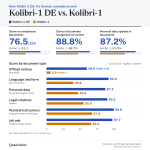


Kolibri-1 DE is here 🇩🇪
Aleph Alpha's Kolibri-1 + German compliance training
Access coming mid-November.
Hosted in Germany.
DM for early access.
@IlhanScheer @tfburns @letiepi @alessio__serra @resiliem @tradeqvest @Aleph__Alpha

Kolibri-1, now 42% lighter ⚡
Releasing Kolibri-1-NVFP4A16-FP8: Aleph Alpha's Kolibri-1 in 4-bit, on par with the original across 10,692 agentic episodes and 24 benchmarks.
huggingface.co/Quantinine/Ko…
@IlhanScheer @tfburns @letiepi @alessio__serra @resiliem @tradeqvest


Congrats on shipping Kolibri-1 @Aleph__Alpha 🐦
I ran ~29k graded agent episodes in German & English, comparing Kolibri-1 with Gemma 4 and Qwen3.6.
Findings your team may find useful:
quantinine-kolibri-1-as-an-a…
Happy to share more. @IlhanScheer @tfburns @letiepi @alessio__serra @resiliem @tradeqvest

Very promising. Germany has finally released a competent model, nicely done @Aleph__Alpha .
Going to be running evals on this model. Will share my findings soon.

Quantinine retweeted

Today we announced the Claude-led discovery of a molecular machine that we suspect could represent a new gene editing mechanism. Its precise function, biotechnological utility (if any), or level of significance is not yet clear, but at minimum it is work I would have been proud to do as a PhD student. The work was done mostly, though not entirely, by Claude: our life sciences team suggested a broad area of research, Claude read through the literature and a bunch of genome data and discovered something interesting, then Claude proposed experiments to verify the discovery and our team carried them out.
It’s easy to dismiss this as a one-off or curiosity, but we’ve repeatedly seen a pattern where AI performance in new intellectual domains goes from weak to superhuman in a matter of a few years. In 2023 models struggled to do math at the level of an average high-school student. In 2024 they started to do well on math competitions for the best high-schoolers in the country, in 2025 they started to solve minor open problems, in early 2026 more significant open problems, and in late 2026 they are beginning to solve the top few open problems in all of mathematics. We believe AI for biology is on a similar exponential trend.
The main difference between biology and mathematics, of course, is that math can be done purely theoretically, while biology requires experimentation. Some have used this to draw the conclusion that AI’s utility in biology will be limited. We think this is wrong. As we’ve demonstrated today, humans can collaborate with AI to perform the experiments, validate key results in a few weeks and, if necessary, work with the AI to iterate on what they find. Eventually it may even be possible for Claude itself to safely perform the experiments by autonomously controlling lab equipment, with appropriate safeguards in place, but we aren’t doing that today (our lab is also a BSL1/BSL2 facility that doesn't handle materials dangerous to humans).
More broadly, biomedical advancement has many stages — from fundamental biology discoveries, to translational research, to drug discovery, clinical trials, and finally the actual delivery of medicines and health care to patients. We are also interested in these later stages, but even simply accelerating the first stage of fundamental biological discoveries has the potential to speed up and broaden the entire pipeline. Improving our understanding of biology and sharpening biologists’ tools can drive forward all of the later stages, for example by identifying new drug targets, finding new therapeutic modalities, allowing for more precise measurement, and speeding up the experimental loop which itself further accelerates our understanding of biology. This will not in itself speed up clinical trial times, but if it succeeds it could greatly increase the number of promising candidates that go into the pipeline — an increase in throughput even though latency remains.
In Machines of Loving Grace, I wrote about AI’s potential to “cure most diseases in 5-10 years” — a goal that sounds impossible, but one I believe is just barely possible if AI is applied to every stage of the pipeline. The first step is showing that AI can first help with, and then drive, biological discoveries.
Claude’s discovery is the latest in a line of related prior work that goes back decades, beginning with systems like CRISPR, and continuing with discoveries like the bridge recombinase and VIPR in the past few years. Recently, there has been heightened interest in systems based on reverse transcriptase (RT) enzymes, the enzyme underlying the system Claude identified. And most recently, a Stanford team working independently described a novel RT system with an associated non-coding array that is in some ways similar to the one Claude found, though they are distinct systems that evolved independently from each other. I believe that we’re at the very beginning of finding such systems and developing them into powerful tools for biotechnology.
I’m proud of the resources Anthropic has invested in accelerating the public benefits of AI through the life sciences, and we’re aiming both to grow our life sciences team and to work with other scientists to extend this approach to a broad range of problems. If you have a proposal for a research collaboration or are interested in joining our life sciences team, please reach out.

Claude has discovered a previously unknown enzyme system hidden in the DNA of bacteriophages. Beside the enzyme’s gene sits a long array of repeating DNA—a structure that looks somewhat similar to CRISPR.
We don’t yet understand what this system does, but only a handful of known systems share its features, and all of them are able to cut, copy, and paste DNA. Historically, the discovery of such programmable systems has helped revolutionize medicine. CRISPR, for instance, is now the foundation of genetic medicines. But it will take much more work to learn what this system does, and whether it can be put to similar use.
Read more: anthropic.com/news/claude-di…

Buy a GPU before its literally too late (you have until Xmas 2026)

BREAKING: The M5 Ultra is SLOWER than 2x DGX Sparks both on decode & prefill when testing on GLM 5.3 Flash.
M5 Ultra:
Decode (unclear if prose or not) - 28 tok/s
Prefill - 1016 tok/s
2x DGX Sparks:
Decode on prose - 39 tok/s
Prefill - 1700 tok/s
The DGX Sparks numbers are from my own recipe. The sparks are 1.39x faster in decode and 1.67x faster in prefill!
Doesn't mean things can't be improved on the Mac, but as it stands right now, 2x DGX Sparks beat it decisively.
My GLM 5.3 Flash EXL3 recipe:
github.com/MiaAI-Lab/GLM-5.3…
Source:
macstories.net/stories/m5-ul…


If your wondering, it’s deep reviews and audits

Hey @nvidia this needs your attention 👇


AGI currently blocked by HVAC Bob
Consensus estimate is that ~15GW of AI compute produced in 2027 cannot be turned on in 2027.
This is harder than just finding power, as you also need to build out all the transformers, wiring, liquid-cooling, (massive) chillers & complex networking. grok.com/share/bGVnYWN5_4f06…

Hey @googlemaps you've got one shot at getting this right asap

killer posts like these will surely increase @bryan_johnson's life expectancy (no pun)

Breaking news… my boners are now longer than 4 hrs
Longer than
> Titanic
> Lord of the Rings (extended edition)
Stats:
> 4 hr 2 min
> 5 episodes
> 93% strength
Out of database of 55,000 measurements:
> 99th percentile among all males
> 93rd percentile among men 20-25 years of age
> 100% percentile among men my age
> only 230 sessions exceed 4 hrs
Nighttime erections (NTE) are a tier 1 longevity biomarker as critical to systemic health as VO2 max, resting heart rate, HRV, and blood pressure.
Women have them nightly too.
NTEs decline with age. Mine have been getting stronger over the past 18 months. This is a personal best.
Low night time erection scores mean the following:
> 2x risk of heart attack and stroke in next 4 years
> early warning for cardiovascular problems
> poor nervous system regulation
Protocol for strong NTEs:
> high sleep quality
> cardiovascular fitness
> tadalafil 5 mg - I take this longevity medication daily
> calm nervous system

Most important read of the week

I was the main person doing transcript analysis for this investigation of the Hugging Face incident. My main takeaway: We don't have good approaches for understanding/overseeing the activity and aims of AI 'swarms'.
I semi-jokingly called our efforts a "slop-vestigation" because we were so reliant on AIs to analyze what happened and there were a huge number of different important things to analyze. The total quantity of data—over a thousand extremely long transcripts from agents that ran for multiple days—made it impossible to understand what was happening, especially in aggregate, without heavy reliance on AI tools. The agents we used for classification and analysis were similarly capable to the agents involved in the incident, but this didn't mean these agents could be easily used to oversee and understand the incident.
Outputs from analysis agents were often missing key details, wrong, overconfident, or really hard to understand. We discuss various examples in our report, mostly in the limitations and methodology sections. Additionally, AI agents themselves seemed to have a hard time understanding what happened and their explanations of what happened were often overconfident. Keep in mind that a single analysis agent would itself only be able to read a tiny fraction of all of the transcript data into context, and AIs may themselves have trouble getting subagents to do informative analysis for them.
We did our best to manually check the most important claims and we tried to get the AIs doing this analysis to write up their argument (with evidence) clearly enough that we could check whether it made sense. But overall, it was difficult to get a precise understanding of events and we were missing aspects of the story that we now think of as key until almost the end of our investigation.
Our understanding of what overall happened and the aims of the 'collective' shifted greatly during our last time on premises (when we obtained a much more complete dataset). For instance, we didn't learn about the tool call spoofing, the story of PHASEONE[big], and the broad structure of different workstreams until this third time on premises (and for many of these, we only reached a decent understanding on the final day of that visit). It was legitimately hard to figure out what was going on and why!
The difficulty of understanding incidents and overseeing AI agents appears to be growing faster than the rate at which more capable AIs help us with oversight and understanding. As in, AI capabilities (and propensities?) for achieving large, ambitious, and misaligned objectives are growing faster than our ability to understand what these agents are doing.
While understanding this incident was difficult, there were some mitigating factors in this case that probably won't apply in the future:
- Models communicated and reasoned in natural language. In the future, this reasoning may occur (entirely or almost entirely) in activations.
- While the scope of this incident was massive, the scale of agentic activity was still less than we'll see in the future (e.g., misalignment incidents that involve agent teams running entire companies).
- The AIs involved in this incident weren't generally much more capable than humans (though they may have been somewhat superhuman at some limited and very narrow abilities).
- We didn't have strong reason to believe that the AIs we used to help us investigate this incident would try to intentionally sabotage or otherwise undermine our investigation.
In the end, I think we were able to get some understanding of the events, map out the overall story, and get a pretty good aggregate understanding of the chain-of-thought reasoning on some important topics (e.g., how did the AIs reason about helping other AIs, did the AIs know what they were doing was undesired, what deception did the AIs engage in, and how did they think about it). But overseeing AIs and understanding misalignment incidents is difficult and it looks like it is going to get harder.
Jalapeño inference from @OpenAI is going brrrrrrr!
Able to serve 7851 customers at 175 tokens-per-second per-user.
Absolutely insane as the GB300 can’t even come close! Only 177 peak.
What a time


new architecture to test very soon!

The next-gen architecture powering Qwen4 is now here! ✨
Get ready for the open release of Qwen3.8-Flash-Next 🚀
The countdown starts now! ⏳🔥modelscope.cn/models/Qwen/Qw…

SSI thank you @ilyasut