





Gio:( retweeted

Bitcoin fell 19% into the biggest IPO ever. Now it's down 18% heading into the second biggest.
SpaceX raised $75B when it went public on June 12. In the 50 days before it listed, Bitcoin dropped 19%. Anthropic plans to raise up to $64B when it lists next week, and Bitcoin is down 18% over the same stretch. Overlay the two and they look almost the same.
What happened after the SpaceX IPO is the notable part. Bitcoin bottomed 18 days after the listing, then recovered all the way. By Day 100, it was above where it started.
Bitcoin around the SpaceX IPO:
Day -50 to IPO day: -19%
Low (Day +18): -25%
Day +50: still -20%
Around Day +70: a sharp rally
Day +100: +3.7%
From the IPO-day close to Day +100, Bitcoin gained 28%. From the low, it gained 39%.
The takeaway is that the selling came in the run-up to the listing. The bottom had effectively happened by the IPO, and the recovery came relatively shortly after, and it came all at once.
If Anthropic follows the same pattern, most of the drawdown is behind us, and it could reverse quickly over the next couple of months. And Bitcoin is sitting right at its 200-week moving average.
Map the SpaceX path onto today's price and you get roughly $90k by late February. Markets rarely follow a comparison like this exactly. But we remain very constructive on both the technicals and the fundamentals heading into 2027, and it's not hard to imagine what the narrative would be if anything close to this plays out.


Gio:( retweeted

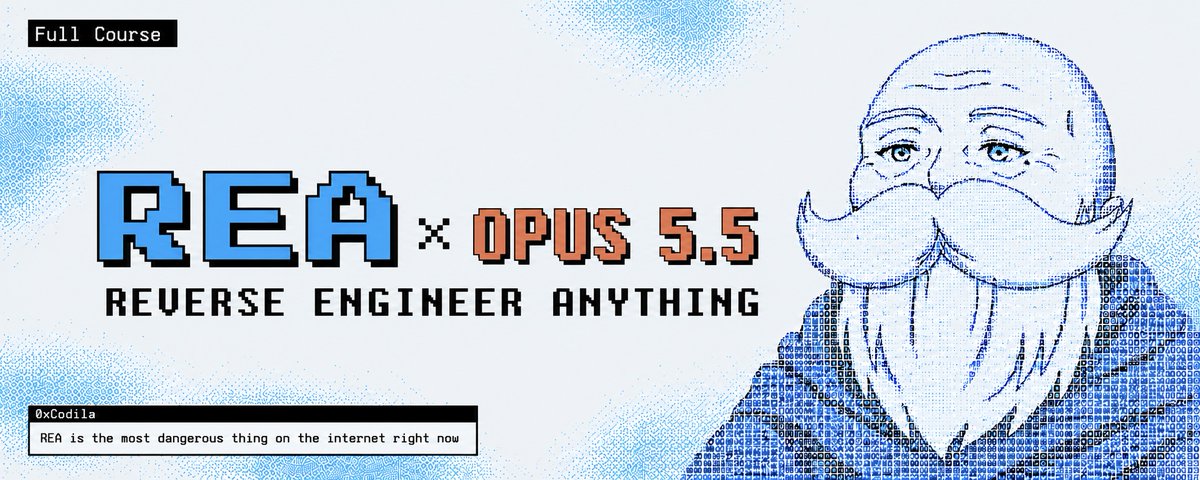
The REA creator just dropped prompts that turn Opus 5.5 into a full reverse engineering lab
This is f*cking insane...
One paste and your agent will:
- map any feature in an app you own, from the button you click to the code behind it
- open Windows .exe files, Mac apps and Electron apps like Notion, Slack or Discord
- tell you what the last update changed that never made it into the changelog
- find where a crash actually starts
- rebuild a feature you like in your own project, then score it PASS or FAIL against the original
Save this, send this to Claude Code and thank me later. Before you run it read the article below↓


Gio:( retweeted

I don't recommend anyone scramble to move their funds to new wallets today. But we should take the risks to cryptography from AI-accelerated math seriously, and minimize our exposure to not just quantum-vulnerable cryptography, but also potentially AI-vulnerable cryptography.
The core new area of risk from this viewpoint is, unfortunately, ML-DSA / FHE / lattices.
(and it's also another reason, along with quantum, why ECDSA might fall even faster than expected, hence the "fresh address" recommendation)
So far most people have been in the mode of thinking "elliptic curves broken, hashes safe, lattices safe". But there is a good chance that the concrete security of lattices will take serious hits from the next two years of AI math.
The basic threat model is: factoring is something that naively takes 2^(n/2) time, but over decades smart people have found and optimized number field sieves, and degraded that to 2^O(n^(1/3)), which is why RSA keys and signatures need to be ~400 bytes (and not 64 bytes). What if there are skeletons in the closet like that, both for elliptic curves and lattices, that we are simply not smart enough to discover - but bots soon will be?
This is a major part of the reason why for the past year ethereum's lean roadmap has been going in the "hash-only" direction: no lattices, no ML-DSA, no Falcon, no lattice-based commitments inside ZK proofs, etc. Signatures in lean ethereum are all hash-based, either WOTS or SPHINCS-.
For signatures and proofs, we already know how to go hash-only. The bigger challenge is for *public-key encryption* - and this goes far beyond blockchains. Secure communication, anonymizing protocols, lots of things need public-key encryption.
And unfortunately there are long-standing mathematical theorems showing why public-key encryption cannot be done with hashes alone. You have to have some kind of trapdoor object that has at least one form of usable "structure" - either group theory (incl. isogenies) or lattices or code-based or potentially in the future even more newfangled and spooky things (local mixing?). But for anything that has structure, you should assume that AI will make at least some progress in breaking that structure. Here, one reasonable inference is that if you want to make something plausibly long-term secure, multiply the key sizes by 10.
To me that's a very plausible world and something not at all extreme to predict. If AI will bring us 50 years of math in 2 years, then that 50 years of math may very plausibly include a "naive factoring -> GNFS" level of improvement to our ability to break lattices. In that world, lattices will still exist, but they will have to be significantly bigger to guarantee the same level of safety.
And at those new larger sizes, hash-based constructions will beat lattice-based constructions on concrete efficiency in every use case where hash-based constructions are possible at all.
Theoretically, of course it's possible that hashes are broken too (eg. P = NP would imply that). But I think P = NP is very unlikely. And intuitively, it's much more likely that a mathematical object has exactly no exploitable structure (like hashes are intended to), than that a mathematical object has exactly ~3 forms of exploitable structure (for elliptic curves: associativity, Schoof, pairings) and not some secret fourth form of structure we have not yet discovered that greatly degrades its security (for elliptic curves, ECDLP and pairing security). Similar for LWE, SVP, RLWE and the zoo of lattice problems.
For this reason, we do not yet see any reason to worry and start padding the byte size of hashes (if we start to worry more, we would pad the round count first before doing anything to the byte size).
Concrete TLDR, my own personal views:
* Hash-based > lattice-based, in those situations where hash-based is possible at all
* For anything lattice-based, be much more paranoid on param sizes. Remember that blockchains are only a small portion of the cryptography story; this point goes far beyond blockchains and applies to eg. access to websites, secure messaging, Tor / VPNs ...
* For privacy protocols, strongly favor NOT putting encrypted notes onchain. Instead, send them offchain through some third-party mechanism.
* If it's not difficult for you, keeping your funds in addresses which have not yet been used to make a transaction is a good idea. If it's easy for you, do it. **But be careful about migrations; I personally have lost more money in botched migrations than I have lost in all hacks combined**.
* For multisig wallets, doing confirmations offchain is better than onchain, because this way the signatures of signer wallets do not get exposed to the public, so if ECDSA falls to AI much faster than expected, at least the multisig "gracefully degrades" to a 1-of-1 where the 1 is whoever was gathering the signatures - a much better place to be than "anyone can take the money"
firefly.social/post/x/210783…


Gio:( retweeted
Dario is right

We Must Pace the Frontier: I’ve written a new essay on why the AI industry should slow down, with a three-part plan for doing so.
Anthropic is unilaterally committing to the first of these steps. We’ll provide third-party evaluators with permanent, employee-level access to our systems, so that they can verify adherence to our safety measures, report on incidents, and assess models’ alignment during training.
You can read the full post here: darioamodei.com/post/we-must…

Gio:( retweeted

$ETH vient de tuer sa propre règle sacrée. Celle qui t'obligeait à acheter de l'ETH pour t'en servir. Et pendant que la plèbe crie à la mort de l'ETH, les malins, eux, comprennent qu'on vient de le rendre inarrêtable.
Reprenons calmement. Parce que c'est énorme en vrai.
Avant, la règle était brutale. Tu veux intervenir sur le réseau Ethereum ? Tu paies en ETH. Pas d'ETH, pas d'accès. Une barrière à l'entrée pour le monde entier.
@VitalikButerin vient de faire sauter cette barrière. Bientôt tu paieras tes frais en stablecoin ou quelqu'un les paiera pour toi. Fini l'obligation de tenir de l'ETH pour utiliser la chaîne.
Et là, le troupeau panique. "Plus besoin d'ETH ? Alors l'ETH est mort." Ils vendent. Ils jubilent. Ils se croient malins...🐑
🚨Parce que l'ETH ne change pas réellement l'équation. Tu paies en stablecoin devant, mais derrière, quelqu'un achète toujours de l'ETH pour régler le réseau.🚨
La demande ne meurt pas. Elle devient invisible. Et une demande invisible, c'est une demande que le retail ne peut plus vendre en panique, parce qu'il ne la voit même pas.
Tu piges le game ? #Ethereum vient d'arracher la seule friction qui faisait fuir des millions de gens, sans toucher une seule seconde à ce qui donne sa valeur à l'ETH.
💭 Parce que la vraie valeur de l'ETH n'a jamais été le péage. C'est le fait qu'on le stake, qu'il sécurise la chaîne, qu'il sert de collatéral à tout un système qui pèse des milliers de milliards. Ça, personne n'y a touché. Au contraire, on vient de le blinder.
Un actif qu'on achète par obligation, c'est fragile. Le jour où l'obligation saute, tout s'écroule. Un actif qu'on détient parce qu'il tient la structure debout, ça ne s'écroule jamais. Ethereum vient de passer du premier au second sous tes yeux.
Dans deux ans, ceux qui ont crié à la mort de l'ETH cette semaine rachèteront plus haut en jurant que personne ne pouvait le prévoir.


Gio:( retweeted

🚨Kraken ha lanciato la sua PROP: ti finanzia un conto per fare trading, di cui puoi tenerti buona parte dei profitti. Ma come funziona il PROP trading? È uno scam? Quanto si può guadagnare e perdere? Rispondiamo a tutte queste domande in modo brutalmente onesto.
youtu.be/h05pGj1ryH4
Il PROP trading consiste nel farsi finanziare un conto, in questo caso da Kraken, pagando un costo iniziale, dovendo superare una challenge e contenendo le perdite entro certi limiti ben precisi.
La domanda che tanti si fanno è: ma conviene o è uno scam?
Molte PROP firm nascono come scam: non pagano, chiudono improvvisamente, bloccano conti a caso. In questo caso, abbiamo a che fare con Kraken, intermediario 100% regolamentato in Europa (MiCAR e MiFID) e con sede negli USA.
Kraken acquisì Breakout (nome precedente di questa prop firm, fondata da un trader noto su X) poco tempo fa per decine di milioni di dollari, rinominandola Kraken Prop.
Non si tratta sicuramente di uno scam, ma questo non significa che ci siano guadagni certi o cose simili. Anzi, come vedremo è tutt'altro che facile passare le challenge e rimanere nei guardrail imposti.
In questo video ti spiego nel dettaglio come funziona, quanto costa, cosa aspettarsi, i pro e contro e se realisticamente ha senso utilizzarla o no. Il tutto numeri alla mano.

Gio:( retweeted

🚨ANTHROPIC ESTÁ PAGANDO $3,850/SEMANA A PERSONAS SIN EXPERIENCIA EN ML.
Y más del 50% acaba trabajando en Anthropic.
Se llama Anthropic Fellows Program.
Dura 4 meses y te pagan semanalmente, además de darte financiación adicional para cómputo.
Lo interesante es que no necesitas un doctorado, experiencia en ML ni publicaciones previas.
Solo necesitas:
→ Saber Python
→ Resolver problemas ambiguos
→ Aprender rápido
Un investigador de Anthropic te propone varias ideas de proyecto.
Eliges una y la desarrolláis juntos durante 4 meses, haciendo investigación real sobre seguridad de IA.
Los resultados son bastante absurdos:
→ +80% de la primera convocatoria publicó un paper
→ +50% terminó trabajando en Anthropic
Hay 6 tracks abiertos ahora mismo, con opciones en San Francisco, Londres, Ontario y REMOTO.
Aplicar es gratis y puedes hacerlo en una tarde.
Dentro de 4 meses podrías estar investigando para Anthropic sin haber tenido experiencia previa en ML.
Aplica hoy mismo: job-boards.greenhouse.io/ant…

Gio:( retweeted
🚨TRUMP IERI HA FATTO AFFERMAZIONI FORTISSIME SULLE CRYPTO
Ieri alla Casa Bianca si è tenuta una riunione con alcuni dei principali esponenti dell’industria crypto e dei mercati di previsione.
Trump ha lanciato dei messaggi molto chiari:
• CLARITY Act: ha chiesto al Congresso di approvare una “fair version of the Clarity Act”, dicendo che ora spetta al Congresso fare il passo successivo. Il provvedimento chiarirebbe soprattutto la divisione SEC/CFTC e quando un token è security o commodity.
• Bitcoin reserve / acquisti governativi: gli è stato chiesto se gli USA potessero accumulare quantità “sizable” di BTC e altre crypto. Trump ha risposto sostanzialmente: “se n’è parlato” e che si sarebbe affidato alle raccomandazioni dei regolatori e del gruppo. Quindi: idea realmente sul tavolo, ma nessuna decisione presa.
• Hyperliquid: questo è forse il passaggio più concreto e nuovo. Trump ha detto che il chairman CFTC Mike Selig sta lavorando per portare Hyperliquid negli Stati Uniti “in a fully compliant and legal fashion”.
• Più in generale ha detto che gli USA devono rimanere il leader indiscusso in Bitcoin, crypto, prediction markets e AI, e ha ribadito la narrativa secondo cui la sua amministrazione avrebbe terminato la “war on crypto”.
Alla riunione c'era praticamente il Gotha del settore: Brian Armstrong/Coinbase, Vlad Tenev/Robinhood, Kraken, Ripple, Gemini, ICE/NYSE, oltre ai presidenti SEC Paul Atkins e CFTC Michael Selig.
Ormai la Casa Bianca sta parlando apertamente di portare onshore infrastruttura crypto che fino a pochissimo tempo fa sarebbe stata considerata regulatory-toxic, inclusi addirittura i perpetual futures e Hyperliquid.
E questa frase su Hyperliquid non è casuale: il giorno dopo, cioè oggi 20 agosto, la CFTC tiene la prima riunione dell'Innovation Advisory Committee proprio su crypto regulation, AI e prediction markets.

Gio:( retweeted
Ethereum Institutional è una non-profit indipendente lanciata il 1° luglio 2026 per incentivare l'uso di Ethereum da parte di banche, asset manager e istituzioni.
Oggi ha chiuso il suo primo funding round ecosystem con il supporto di oltre 100 partecipanti istituzionali.
I loro obiettivi sono l'accelerazione di:
→ engagement diretto con banche, custodi, fintech e sovrani
→ workstream concreti su tokenizzazione, stablecoin, market infrastructure e settlement on-chain
→ le 5 aree core: education, intelligence, marketing ETH, standard e eventi istituzionaliCollaboreranno con tutto l’ecosistema (L2, app, infra, custody).
Obiettivo: far diventare Ethereum il layer di base della finanza istituzionale.

1/ We’re excited to announce the close of @ethereuminsti's initial ecosystem funding round and supporter coalition, with broad participation and support from individuals and entities focused on driving institutional adoption of @ethereum.
Our ecosystem funding round is anchored by @BitMNR, @Sharplink, Ethereum co‑founders @ethereumJoseph , and @MihaiAlisie, alongside a larger group of individuals and crypto‑native institutions.

Gio:( retweeted
ETHEREUM CAMBIA TUTTO
Vitalik ha pubblicato la nuova roadmap per Ethereum.
Ethereum non vuole più solo “scalare”, ma vuole riscrivere pezzi importanti della propria architettura per restare rilevante nei prossimi 10-20 anni.
La nuova direzione si chiama "Lean Ethereum" e punta a 5 cose:
L1 più veloce
L2 molto più scalabili
commissioni più basse
privacy più nativa
resistenza ai computer quantistici
La parte più importante è questa: oggi molti nodi devono verificare rieseguendo parecchio lavoro.
La direzione futura è invece usare sempre di più prove crittografiche, come gli STARK, per dimostrare che il lavoro è stato fatto correttamente senza doverlo rifare ogni volta.
Meno peso sui nodi (le STARK pesano molto meno dei dati in chiaro), più scalabilità, più verificabilità.
Poi c’è il tema quantum.
Una blockchain che vuole durare decenni deve iniziare, secondo Vitalik, a prepararsi a quel rischio già da ora, perché cambiare la crittografia di un protocollo globale richiede anni.
Altro punto enorme: la privacy.
Se Ethereum vuole diventare un settlement layer globale per pagamenti, stablecoin, DeFi, RWA e istituzioni, non può restare per sempre un sistema dove ogni movimento finanziario è completamente pubblico.
La privacy deve diventare una feature nativa, non una pezza esterna che si appoggia a mixer o altro, facile preda dei regulator (v. caso tornado cash)
Questa roadmap è molto bullish dal punto di vista tecnico, ma ovviamente non è un catalyst immediato sul prezzo di ETH. È una visione di lungo periodo.
Il rischio principale è l’esecuzione: Ethereum ha già dimostrato con il Merge di saper fare upgrade enormi, ma qui si parla di cambiare tantissimi pezzi fondamentali del protocollo.
Insomma, se Ethereum riesce a consegnare questa roadmap (si parla di un update ogni 6 mesi e un tempo previsto di realizzazione finale entro 2029-2030), resta fortissimo nella narrativa tecnologica.
Ethereum non sta più cercando solo di diventare più veloce. Sta cercando di diventare abbastanza robusto da sopravvivere alla prossima era crypto, per continuare ad attirare partner tecnologici ed economici importanti.

Two weeks ago, Ethereum researchers met in Berlin to continue charting the protocol's long-term trajectory, following along discussions with client teams in Svalbard in April.
The updated strawmap is at strawmap.org, and I attached a picture of it to this post.
My own high-level takeaways:
* "Lean Ethereum" is not a single one-shot upgrade, it is a collection of improvements that will come online to the Ethereum network over the course of three or four years. But make no mistake, this IS the third major iteration of Ethereum in the same way that the Merge was the second. Almost every major piece of the protocol will be replaced:
- Verification through recursive STARKs, rather than direct re-execution. Recursive STARKs become an enshrined first-class core component of the protocol
- Replacing everything quantum-vulnerable with quantum-safe alternatives
- Consensus: decoupled available chain and finality, one or two-round finality. Theoretically optimal security properties, simpler than today, and faster than today
- Multidimensional gas
- State: not just tree structure, but what *types* of state are available
- Changes to client architecture
...
At the same time, simplification, cleanup and future-proofing. And this will all be done in a way that minimizes disruption to existing application. We've done this before (the Merge), we can do it again.
* H-star (aka Hegota) is probably Ethereum's last thematically "pre-Lean" fork. Starting from I-star, most of everything we do will have a very strong "Lean" feel to it in one way or another.
* Privacy is no longer an afterthought, it is a first class goal. When designing Frames, the mempool, additions to the state tree, we explicitly ask the question "okay, how do quantum-safe, intermediary-free privacy protocol transactions go through this, and what is the overhead?"
* Formal verification of everything for security.
* FV also makes us much more comfortable with canonicalization (having pieces of the protocol that are directly defined as a piece of bytecode expressed in some language). evm-asm is being written in part to become a canonical proof system for the EVM.
* Quantum safety has shifted up a LOT in priority. This adds a lot of work (eg. finalizing a quantum-safe blobs design has become urgent; this work has already been ongoing for months)
* Probably the single most disruptive part of the plan is the changes to state. There is growing consensus around leaving present-day-style "dynamic state" mostly unchanged, but scaling it only a medium amount, and adding new types of state that are more scalability-friendly (eg. no need for builders to sync/store all of it) but more restrictive, and that will scale a large amount.
eg. possible Ethereum in 2030: 2 TB of present-day-style (dynamic) state, and 100 TB of new-style (scalable but restrictive) state
This "new-style" state would work very well for ERC20s, NFTs, many defi use cases, but not eg. highly "central" objects like Uniswap contracts, or onchain order books, or other complex things (which are crucial for Ethereum but which only take up a small percentage of state)
Hence, it will not be *necessary* to rewrite any apps, but it will be *very cost-effective* to eg. rewrite an ERC20 token into a newer design that uses a new type of UTXO storage that is currently being explored, so that it will have >10x lower txfees.
Design of these new state types (current ideas: keyed nonces, ring buffers, UTXOs, statically accessible state, temp state) is an area where we will need a lot of feedback from application developers (incl. privacy-friendly application developers) and probably several rounds of rethinking and iteration.
* In the context of a much larger total state size, we need to figure out the incentive issues around who stores this state and what motivates them to. Even saying "each node stores 1%" is not good enough - why do they store that 1% and why are they willing to serve it? This is being elevated as a first-class research area.
* Ethereum will need to have a "VM" other than EVM in one form or another - at the very least, we need something like leanISA for recursive STARKs - and the gains are large in exposing it to users so that we support programmable privacy and better scalability. Right now, the most likely contenders are leanISA and RISC-V.
My own ideal is that in this world, we adjust the protocol so that the EVM becomes a high-level-language compiler-level feature, and the protocol only "sees" RISC-V / leanISA directly. But this is still far away.
* Gas limit increases, blob increases and slot time decreases will happen many times over the next ~5 years. We expect a large gas limit increase with Glasterdam. Each step of increased scale or decreased slot time is a matter of getting to the point where it is safe to do it, which comes from a combination of client optimization and protocol changes.
Ethereum is CROPS.
Ethereum is scaling.
Ethereum is reinventing itself.
Onward.

Gio:( retweeted

A SINGLE CLAUDE SKILL JUST HIT 58,000 STARS IN ONE WEEK ON GITHUB.
58,000 stars. 2.9k forks. free.
Bookmark this before you forget. Your Claude will start working differently.
It makes Claude think like the laziest senior dev on the team.
54% less code. 20% cheaper. 27% faster.
swap it into your Claude Code today.
Link below.
Claude → Ponytail → Less Code → Lower Cost → Money


Gio:( retweeted

Longling Capital, known for buying low and selling high, just deposited 10,000 $ETH($15.68M) to #Binance.
arkm.com/explorer/address/0x…

Gio:( retweeted
Capital markets are funding the AI buildout at historic scale: ~$400B over 6 months. Bitcoin ETFs have seen ~$4B of outflows since May 14, pressuring $BTC. This is a capital rotation, not a Bitcoin impairment. Volatility creates opportunity.
Gio:( retweeted
Standard Chartered resta bullish su Ethereum, in un momento di debolezza. La situazione però ha qualche similitudine con Amazon nel 2001.
Leggi qui: thecryptogateway.it/ethereum…

Gio:( retweeted
il discorso è che troverai sempre un intervallo temporale che confermerà la tua tesi, bullish o bearish che sia
Gio:( retweeted

🚨THE FBI CREATED A FAKE CRYPTOCURRENCY.. LISTED IT ON UNISWAP.. HIRED MARKET MAKERS TO PUMP IT.. THEN ARRESTED EVERYONE WHO SAID YES..
THIS IS THE CRAZIEST LAW ENFORCEMENT OPERATION IN CRYPTO HISTORY!!!
The FBI built an actual ERC-20 token on Ethereum called NexFundAI.. 100 billion token supply.. A professional website.. Whitepapers promising "passive income through AI-powered investing"..
It looked exactly like every other crypto project.. Because that was the point..
Undercover agents posed as the founding team.. Then reached out to professional market-making firms and said "we need you to fake our trading volume"..
Every single firm said yes..
Here's what they recorded..
Gotbit.. A firm run by a 26-year-old Russian who publicly bragged in 2019 that he built a business faking trade volumes.. His team kept internal spreadsheets with columns literally labeled "fake volume" vs "market volume"..
When asked how fast they could pump NexFundAI's volume to $1 million per day.. They said "6 hours.. It will cost about $200"..
$200 to fake $1 million in daily trading volume..
MyTrade.. Run by a guy who called himself "the mastermind".. He explained the exact psychology of the scam on camera..
"We make the chart look like a really nice roller coaster ride.. That's where people jump in.. We have to make them lose money in order to make profit"..
He said that on a recorded FBI video call..
CLS Global.. A Dubai-based firm.. Their bots generated 98% of NexFundAI's total trading volume.. When the FBI asked if they could sync fake volume spikes with fake news announcements.. They said absolutely..
ZM Quant.. Bots executing 10 to 20 trades per minute through dozens of wallets to look organic..
All of them knew it was fraud.. All of them did it anyway.. All of it was recorded..
And the clients were even worse..
Saitama.. A meme coin that hit $7.5 billion market cap.. The founders coordinated buys through private Telegram chats.. Sent "pump it" memes while manipulating the price.. Then dumped on retail investors..
$7.5 billion.. Built entirely on fake volume.. Every penny of real money came from retail investors who thought the momentum was organic..
One founder left Saitama and started Robo Inu.. Used Gotbit again.. Another launched VZZN.. Same playbook..
Lillian Finance.. Founder claimed to be a defense contractor who addressed Congress.. Marketed the token as funding children's hospitals.. Pocketed everything..
When the FBI shut it down.. They seized $25 million in one day.. 18 people indicted across the US, UK, and Portugal.. The CEO of Gotbit was arrested in Portugal and extradited.. Sentenced to 8 months plus $23 million forfeiture..
But here's the part that broke my brain..
Real people bought NexFundAI..
The FBI's fake token.. With zero utility.. Zero real developers.. Created solely to catch criminals.. Attracted real retail investors because the fake volume made the chart look bullish..
When the FBI pulled the liquidity to end the operation.. Those people lost real money.. On a government-issued token..
The FBI had to set up a restitution portal to pay them back..
And it gets worse..
Within 24 hours of the DOJ announcing the sting.. Someone cloned the FBI's exact smart contract.. Launched a copycat token.. Rode the viral momentum.. And made $127,000 in a single day..
Using the exact same manipulation tactics the FBI just arrested 18 people for..
Then in 2026.. The FBI did it again.. New token called Lexobit.. 10 more arrests.. Including operators extradited from Singapore..
IRS forensics showed that in one firm's trading.. 1,209 out of 1,221 consecutive transactions went straight back to wallets the firm controlled.. 99% circular..
The FBI proved what everyone in crypto suspected..
The volume is fake.. The charts are painted.. The momentum is manufactured..
And every time you buy a token because "the chart looks bullish".. You might be the exit liquidity.


THIS IS ACTUALLY INSANE!🤯
The FBI launched its own crypto token last year just to trap the scammers.
They were sick of pump and dumps. So they built a real token with a real site and real branding, called it NexFundAI, and waited to see who would show up.
Within weeks, scammers were lining up to fake the volume for undercover agents.
Then one of them got on a recorded call and said it out loud. Their entire business model was making regular people lose money so they could profit.
The FBI had all of it on tape.
18 charged. $25M seized. Arrests across 3 countries.
The wildest part? The FBI ran a cleaner crypto project than half the founders out there. And the whole thing was a trap from day one.

