

M5 @CleClinicLCM. CS '21 @michiganstateu. Interested in artificial intelligence, health tech, and entrepreneurship. Always a student.
Cleveland, OH
Joined December 2022
- Tweets339
- Following157
- Followers74
- Likes188
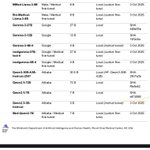


We took like 20 years from the advent of the Internet to arrive at a set of useful abstractions and practices. Below is one step in an accelerated version of the same thing with agents. Cool to see and maybe distill to other domains

I actually agree with a lot of what @poteto is saying except for the central point. IMO most people don't have actual software factory systems. They've just made it much easier for people to ship with AI, so they assume the category doesn't exist. That's more a lack of vision than anything else.
Our conceptualization of a software factory is a system where every piece of work goes through the same stages to standardize the process not the work output.
For us, this standardized process begins with what we call a signal. This is anything that tells you how your software should evolve, including the first signal that your software should exist at all. A Slack thread, a Linear ticket, a Sentry alert, a failing CI job, a tweet, someone's idea.
There's two ways in for a signal. A person picks it up and builds it with Droid, or a workstream picks it up on its own, triages it against a goal someone set, and has droids write the spec and open the PR. Most work still starts with a person, but a growing share comes from workstreams.
Then every change goes through the same checks no matter who or what wrote it. Droid review, security review, a risk judge that can't see who wrote it, CI, and an agent that QAs it on a live preview. Your validation has to be really high quality whether a human or AI built it. The goal of validation is to hillclimb your "regret-free merge rate" until you can automatically merge most changes (or fix them until they can be automerged).
Then it ships, and when something breaks in production we trace it back to the PR that caused it. That becomes another signal. It's also how we know if the checks actually work. If the risk judge approved something that later broke, we find out.
It's the same way we let self-driving cars on the road. Nobody just flipped a switch. We agreed that once they crashed less than human drivers, they could drive. Do the same thing with code. Once AI-written changes break things less often than human ones, and you can actually measure that, you let them merge.
That doesn't mean you turn on automerge tomorrow. Most of our changes still get a human stamp. But once you have automerge, workstreams and a risk score together, you basically have software that improves itself from the signals you choose to track.
The human element becomes obvious if you have a system like this. People remove themselves from the actual process line and begin to define the rules by which the process operates. What to watch, goals and owners, skills, review guidelines, and how much autonomy each workstream gets. They're the regulators.
I think the 1920s factory that a lot of people picture is the wrong idea. That was people doing the same motion on a line all day. This is closer to a Star Trek replicator. You say what you want and it gets made, because the patterns are already stored and how things get made is the same every time, and checked every time.

2
70
This feels true until you confront the possibility that human outcomes may suffer because you have a human bottleneck on decisions the model could capably make by itself

Co-sign. The only future that is worth building is one in which AI remains a tool in human hands, used to elevate the human condition.
21
I can see this method - executed during some kind of sleep / dreaming phase - also solve continual learning + get something closer to human-like reasoning from the models

this should be very obvious but: pointing models at their own brains and getting them to accurately understand what's going on and effectively make changes that cause large shifts in behavior and capabilities is like one of the most dual use technologies imaginable
knife's edge
1
57
Bruh

We asked GPT-6 Astra to edit Qwen3.5-0.8B weights to improve math.
It directly changed only 0.016% of weights, fixing 0.8B's reasoning loops & improving math up to 6x and even instruction following 3x, without gradients or training.
We call this Weight-Space Programming: frontier LLMs can now natively read/write neural network weights! 🧵
Blog: rikiyat.github.io/blog/weigh…

Readers added context they thought people might want to know
LLM was given weights explicitly as text in prompt and used code/forward passes (per authors' logs) to ablate Qwen looping direction, a known thinking-mode issue per model card. Primarily fixed repetition in that mode, not general 'natively' improving weights/math.
rikiyat.github.io/blog/weight-sp…
github.com/RikiyaT/lm_und…
huggingface.co/Qwen/Qwen3.5-0…
huggingface.co/RikiyaT/Qwen3.…
16
This closely resembles how I make slides for talks now. Ask AI to explore the usually messy repo -> create outline -> I review and revise -> storyboard -> I review and revise -> final slides
This needs some work and isn’t perfectly efficient but outputs something acceptable imo

my hypothesis for why AI-generated slides for technical presentations are so awful:
people who don't have a lot of experience presenting think that to make a talk you just put all of the stuff you want to talk about on the slides, then you go through each slide and say the stuff the slide says.
how you're actually supposed to prepare a presentation: you decide what to say, write it out as a rough script, then put maybe 3% of the text on the slide, plus a bunch of visual aides (e.g. plots that only include data you're planning to discuss).
AI-generated presentations are mostly the former. they have a ton of stuff the presenter never mentions, and the stuff that is most useful for the presenter is absent or not highlighted. they include enough content for a presentation 10 times longer than the actual presentation is supposed to be.
maybe try doing it the other way: first write the script for what you actually want to say, and make sure you can say all of it in the time you have. then prompt the model to create the slides based on the script. ask it to use as little text a possible, and a minimalist visual style rather than the claude house style. you can thank me later (I accept both venmo and zelle).
1
43
Sameed Khan retweeted

It seems deepmind might have solved continual learning. Somewhat faster than I anticipated but not by much. This will radically change everything once fully scaled up, including opening the door to AGI and conscious machines. research.google/blog/the-sle…

Sameed Khan retweeted

Everyone who has an anti-AI detector bias loves these posts about misclassifying the US Declaration of Independence but it is important to realize:
1) Pangram is very accurate
2) GPTZero is okay
3) ZeroGPT (shown in this screenshot) is bogus
and 4) your experience from 2 years ago or what you read in a news article then is not reflective of the performance of current models


My half-serious AGI-might-happen benchmark for a long time was figuring out Python versioning errors for deep learning libraries lol but that’s been a non-issue for a little while now


2
82
Sameed Khan retweeted

I think AI will be a transformative technology like the internet by which I mean it will buy us another 2-3 decades of 2.5% GDP growth.
Once you peer past the quasi-religious AGI hype you can start to see the shape of what the real economic value of AI is

a brand new model paradigm! introducing 𝚌𝚕𝚊𝚒𝚛𝚒𝚌: a system one model for extracting, computing, estimating, and predicting values from unstructured inputs.
blog.cloudflare.com/clairic-…

1
2
113
This looks less like mass labor replacement and more on the scale of a better business technology — worth billions in value and game changing but not apocalyptic. Once the capital for subsidized tokens dries up I think the above is what will be driving most of the wealth creation
1
1
21
Note: “0% hallucination” =/= “doesn’t make a mistake” - they are saying they guarantee that the output will be structured and schema compliant so you will get a value you can anticipate with deterministic code. But it can still give you a wrong answer.

After co-inventing ChatGPT, I kept asking myself: why have superhuman chat models not led to AGI?
I’ve spent the last 2 years in stealth building a new way to train models (RLCD), and a new type of frontier AI model that we are releasing today: Jev
• 20-200x faster
• 40-400x cheaper (w/ output tokens free)
• Frontier composable intelligence optimized for decisions
AFAICT the shortest path to AI-based economic revolution
55
Sameed Khan retweeted

I have a new favorite editor/IDE: Zed. Open-source, blazing fast, built-in AI operability, easy to use. Heard that lots of developers are dropping Visual Studio Code for Zed. Has R and Quarto extensions. zed.dev

Sameed Khan retweeted

93 million CT scans were performed in the United States in 2023. About a third covered the abdomen and pelvis. The colon is in the picture on every one of them, and almost nobody was looking at it.
A model published in Annals of Oncology this spring reads the colon on the noncontrast CT that was ordered for something else. In 18,419 consecutive real-world scans, it ran at 86.6% sensitivity and 99.8% specificity, with a positive predictive value of 63.4%. Five cancers nobody had found. About 30 seconds a scan. Ten radiologists using it gained 20 points of sensitivity.
This is not a colon story. Next month it will be a different finding on a different scan, and the month after that another one. Each arrives as a paper, then a vendor, then a question for a radiology department that answered the same question last month for a different tool. Departments deciding tool by tool cannot keep up, and most have stopped trying.
Hospitals already have the structure for a stream of new capabilities that each need an evidence bar, local validation, a pathway before adoption, monitoring after, and a process for removal. It's called a formulary. New drugs arrive every month and no hospital relitigates whether to have a pharmacy. Radiology needs the same committee for algorithms. The platforms to plug them in already exist. The committee mostly does not. Then the part I care about. I order the scan for a kidney stone. At 2 am the read comes back: stone, and a flag. Probable colorectal mass, model-detected. What do I do with that?
Today the honest answer is that I tell the patient, I write "follow up with GI" on the discharge paperwork, and the loop closes some of the time. The ED already has a process for results that arrive after the patient leaves. Positive cultures get a callback, a nurse, a list, a phone call until someone answers. A model-detected mass belongs in that process, with an owner and a tracking list. Referral is the easy part. Whether the scope happens is the system.
One more thing radiology will have to contend with. A local validation takes months. The model's successor ships in three. Validating once and deploying forever cannot work at this cadence. The tool has to be checked the way a lab analyzer is checked, continuously, against known results, with an alarm when it drifts.
A model can now find a cancer on a scan nobody ordered it for. Who owns that result?

Sameed Khan retweeted

Takeaway: stop working on verifiable, pure-digital-world, well-known tasks. These tasks are going to be solved by those with maximum compute and most intelligent models. Three ways out:
- Non-verifiable tasks, e.g., writing, art, designing a new product, etc.
- Tasks involving physical world or humans, e.g., robotics, manufacturing, sales, education, etc.
- Niche domains, e.g., Quant where public information is rare (but nothing stops AI from self-evolving in Quant given its verifiability)

We congratulate Levent Alpöge and Tristan Buckmaster on their remarkable mathematical work.
We (the researchers and the agents) did not see any of their work through any means until they released it publicly — in particular, no specific user data was accessed in order to solve this problem.
While unlikely, we cannot rule out that de-identified data derived from their usage of our products helped improve our models.
However, our proofs differ significantly and even the precise results proved are different in the Euler case (forced vs. unforced).
Sameed Khan retweeted

arXiv -> quickarXiv
Papers are often written in convoluted language that is hard to understand
Swap arXiv -> quickarXiv on any paper URL to get an instant blog with figures, insights, and explanations. Now extracted with @Zai_org's GLM OCR 🚀
Also includes code + author tweet
Sameed Khan retweeted
🚢 Marin 535B-A23B started training this week! As usual, the whole process is open.
Voyage plan: pretraining (80%) + midtraining (20%) on 18.75T tokens on 11 x GB200 NVL72 for ~3 months (2.7e24 FLOPs). Post-training will follow.
Before kicking off the run, we trained a 4-rung scaling ladder from 1.6B-A61M (48B tokens) to 27.7B-A1.2B (926B tokens) to debug issues, and to make a forecast of our hero run. This is by far our biggest run, so definitely expecting the unexpected.

Sameed Khan retweeted
The gold standard for producing PDF documents (especially books and journal articles) has been LaTeX. @typstapp re-engineered the entire process in an incredibly elegant extensible way. On my MacOS LaTeX (TexLive) takes 9.1GB of disk space. Typst takes 43MB. Not a misprint.
Sameed Khan retweeted

watermarks-remover for AI content reaches ~11k stars on github.
People really hate the watermarks. And i fully understand them.


WATERMARK STRIPPER HITS 10,000 STARS DAYS AFTER ANTHROPIC SHIPS PROVENANCE
Anthropic detailed how Claude's text watermark works last week.
By this morning a MIT-licensed repo that strips it has 10,000 stars, targeting Claude, SynthID-Text and OpenAI marks, plus C2PA and EXIF in images and PDFs.
github.com/guillaumemeyer/wa…
