






Tom Fiddaman retweeted

I know this is a predictable opinion from me but I don't agree with the strong emotional reaction against the anti-data-center movements that I've seen this week.
As I see it, algorithmic progress means that whatever you would be able to do with more and bigger data centers in 2 years, you will be able to do with the data centers we have today in 4 years - probably sooner. So nothing remotely apocalyptically bad will happen from even extreme levels of success by anti-data-center people.
Meanwhile we need all the time we can get to better harden the world against both already-visible cybersecurity issues and any bio and other risks soon to come. Science applications are bottlenecked by many things other than AI, so slowing AI down by one year will slow those down by much less than one year.
Given this, a slowdown in compute hyper-scaling seems quite net good? Notice this is without any controversial "doomer arguments", RSI etc. Even if net-bad, it's certainly not worse than like 10+ other political things.
Tom Fiddaman retweeted

Every time I hear "10 sigma" event...


BREAKING: Brazil's -19.8% stock market crash on Monday was one of the rarest market events in the last two decades, according to our analysis.
Brazil's EWZ ETF plunged -19.8% on October 26th, marking an 8.4 standard deviation move.
For context, the ETF's average daily move over the last 20 years has been just +0.04%, with a standard deviation of 2.36%.
Under a normal distribution, the probability of a decline this extreme is approximately 1 in 58 quadrillion.
In other words, this event should be virtually impossible under conventional statistical models.
What just happened in Brazil was *almost* impossible.

Tom Fiddaman retweeted

Dear Nassim @nntaleb,
I’ve seen you refer a few times to @stephen_wolfram's recent finite-state-machine experiments with the Prisoner’s Dilemma, and in particular to his finding that some of the more complicated strategies vastly outperform Tit for Tat. Since I think you and I may still be speaking past each other about what bothers me here, I wanted to spell out my position carefully.
I wrote out this long note with the help of ChatGPT. The ideas and arguments are mine; the language is ChatGPT’s, with my approval.
1/ First, I’m not trying to defend the Prisoner’s Dilemma, game theory, or simple models as adequate descriptions of the real world. Maybe they are adequate, maybe they aren’t. That’s a separate question.
What I’m interested in here is much narrower. I want to compare simulations with simulations — Axelrod’s, Nowak and Sigmund’s, and Wolfram’s — and ask what their results actually show.
2/ Stephen does something interesting and very much in his characteristic style. Instead of hand-picking a few strategies and having them compete, he enumerates all finite-state strategies of a given size and has every strategy play every other strategy in an iterated Prisoner’s Dilemma.
He then ranks the strategies by how well they did against this initial, uniform field of opponents. Some complicated strategies substantially outperform Tit for Tat.
Fine. I believe the computation. But then, essentially, he stops.
3/ This is the key point for me. There is no next generation in which the successful strategies become more abundant and the unsuccessful ones become rarer. There is no repeated selection changing the population of opponents.
Stephen has performed what amounts to one round of an evolutionary tournament: everybody plays everybody, their scores are calculated, and we see who did best against the original population. But the population itself is not then allowed to evolve.
4/ That matters enormously because the original population contains every strategy in equal abundance, including lots of terrible ones: unconditional cooperators, easily exploited strategies, and other “suckers.”
A strategy that is particularly good at exploiting those weak strategies can score spectacularly well in that first tournament.
5/ But suppose we now use those scores to form the next generation. The suckers become rarer or disappear. The successful strategies become more common. Everybody now faces a different distribution of opponents.
So you run the tournament again. And again. And again.
What succeeds in round 1 need not succeed in round 10, or round 1,000, because the strategies themselves create the environment in which subsequent selection occurs.
6/ This isn’t merely a hypothetical objection. Decades ago, Martin Nowak and Karl Sigmund took a closely related methodological approach. They considered an entire parameterized family of strategies rather than a few hand-picked favorites, started with a broad distribution across strategy space, and then did the crucial thing that Stephen does not do here: they let the population evolve.
7/ What happens is fascinating. Early on, nasty strategies can flourish by exploiting weak ones. But as the weak strategies disappear, the ecology changes, and reciprocal strategies can prosper.
With errors present, more forgiving strategies can emerge. If the population becomes too forgiving, exploiters can invade again. The result can be extraordinarily long evolutionary transients and cycles.
8/ So there may be no meaningful sense in which one strategy simply “wins.” Success is frequency-dependent: it depends on which other strategies are currently abundant, and those abundances themselves change through selection.


Tom Fiddaman retweeted

CHEERS! Please join us in congratulating all the award winners for their remarkable achievements!✨
🔗 List of Awardees: ow.ly/SFP050Zv11r
#SystemDynamics #systemsthinking #ISDC2026


Tom Fiddaman retweeted

Why do some countries embrace AI more quickly? Management practices and whether firms encourage AI use among their workers are strongly linked to adoption rates, according to this new research bit.ly/4vxuSLn

ALT A scatterplot shows the relationship between firms’ AI adoption rates and overall management scores for the U.S. and eight European countries.
Tom Fiddaman retweeted

A recent viral graph found fewer days in the contiguous US above 95F/100F/105F today than in the 1930s.
But the graph is misleading – it fails to correct for changing measurement times and techniques, and overstates regional warmth. I take a deep dive at The Climate Brink.

Tom Fiddaman retweeted
We had at #RWRI a monstrously central discussion involving 3 among the smartest humans I know: @financequant , @DouadyPrimers, @stephen_wolfram.
The idea is the error of favoring parsimony:
toy models failed us in the past (excessive degrees of abstraction) but richer models exhausting nearly all possibilities happen to work because we have a looooot of data.
Take prisoner's dilemma and make all strategies play all strategies under path-dependence, the simplistic tit-for-tat is vastly outperformed by richer sets of rules.


I was surprised that in @stephen_wolfram's analysis, he didn't address any of the conclusions that emerged from Axelrod's prisoner's dilemma tournaments: successful strategies tend to be nice, forgiving, retaliatory, and clear. Still true, or not true, in Stephen's experiments?
Tom Fiddaman retweeted

The "wedges" paper behind the useless "all-of-the-above policy" that has persisted for 20 years was not only funded by British Petroleum (@bp_plc) but also involved regular email exchanges between BP and the authors.
The paper pushed carbon capture, fossil gas, "efficient" coal, blue hydrogen, and electro-fuels, all useless technologies promoted by fossil interests, along with other useless all-of-the-above techs, nuclear and biomass.
No wonder the world is so far behind solving our problems. Even science can't escape fossil shenanigans.
propublica.org/article/wedge… @propublica @Princeton @StanfordEnergy @StanfordWoods @Stanford @NaomiOreskes @MichaelEMann @DoctorVive @swaziadam @PeterKalmus @BenFranta
The paper
acee.princeton.edu/wp-conten…


Tom Fiddaman retweeted

Today, the Stanford @DigEconLab launches the AI Economic Indicators, a new platform for tracking how AI is reshaping work, productivity, adoption, and the economy.
1/6

Tom Fiddaman retweeted

Please just stop. The American people will own parts of these companies through their 401K. We don't need a permanent vehicle of regulatory capture. cnbc.com/2026/06/05/trump-op…

Tom Fiddaman retweeted

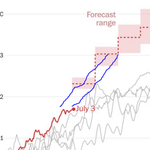
Does El Niño forecasting have their own version of a "hot models" problem?
There are currently 13 seasonal forecast ensembles used to predict future El Niño / La Niña.
Diversity is good, but there remains broad disagreement among them, with some suggesting all-time records.
🧵

Tom Fiddaman retweeted

I keep trying to explain to people, but America doesn’t have a viable 3D printer company because we don’t have any of the underlying architecture.
Shocking how many people think a complex product is some singular thing you build at a “factory.”
A 3D printer is really just a featherweight CNC mill, so much so that they speak yeh same language (G-Code). You need:
- micron accurate linear rails
- Sub micron bearings for those linear rails.
- High resolution servo/stepper motors.
- Motion control chips and boards and stuff.
- Sheet metal, injection molding, various coatings.
America has *no* industrial base for *any* of this at consumer product scale. We invented or definitively innovated everything above, then the McKinsey set came in and convinced us to ship it all to China for the last 40 years.
So yea, sure… you can screw a 3D printer together in America, at great expense… but you are doing so with primarily Chinese components.
What we need is a bunch of uninvestible (by venture funds) businesses that are boring and competently supply a bunch of even more boring, medium margin, no-moat components.

This is what I keep coming back to. So many companies in the US and Europe, driven out of the printer business over the last few years. Each one was its own thing, there was a place for everyone, and we were all friends sharing innovations across the industry. Now everything is just a copy of a copy of a copy 📉
I'd do anything I can to make that possible again. I miss a lot of my friends from this business.
Tom Fiddaman retweeted

Physics-based weather models still beat AI when it matters most. Not on average. On the most extreme days.
This is the opposite of what we've been hearing...
A new paper in Science Advances ran every major AI weather model: GraphCast, Pangu-Weather, Fuxi, against ECMWF's HRES across 162,751 record-breaking heat events, 32,991 cold records, and 53,345 wind records in 2020.
On average conditions, the AI models win. GraphCast, Fuxi, and the rest outperform HRES on standard temperature and wind benchmarks across most lead times. This matches what every prior benchmark study has shown. AI weather forecasting is genuinely impressive.
Then the researchers asked a different question. What happens when the event is unprecedented? Not extreme. Not the 95th percentile. Actually beyond anything in the training data.
HRES won every single category. Heat records. Cold records. Wind records. Nearly every lead time. The performance gap was largest at short lead times, where AI models should have the most information and the least uncertainty.
The bias pattern is pretty massive. The AI models systematically underestimated how extreme the events were. The bigger the record exceedance, the larger the underprediction. The researchers describe it as an implicit 'soft cap': the models behave as if they can't forecast values much beyond the most extreme thing in their training data. The bias grows almost linearly with how far the event exceeded the record. HRES showed no such pattern.
This isn't a fluke. The same result held in 2018 and 2020, which had opposite ENSO conditions. It held across the tropics, subtropics, mid-latitudes, and high latitudes. It held for all three variables. It held when the researchers ran an alternative evaluation specifically designed to avoid the forecaster's dilemma.
The mechanism is pretty straightforward. AI weather models are trained on ERA5 reanalysis data from 1979 to 2017. They learn to interpolate between historical weather patterns. When a new initial condition arrives, they find the nearest analogues in training and produce something in between. Record-breaking events, by definition, have no close analogues. The model has never seen anything quite like this, so it regresses toward the most extreme things it has.
Physics-based models like HRES don't work this way. They solve partial differential equations describing atmospheric dynamics. They don't need a historical analogue for a 48°C heatwave in Siberia. The physics doesn't care whether it's happened before.
The authors are careful about what this means. AI models remain faster, cheaper, and competitive on average conditions. Probabilistic AI forecasting is developing rapidly. Data augmentation with simulated extreme events and hybrid physics-AI architectures are plausible paths forward. This isn't a verdict on AI weather forecasting broadly.
But the policy implication is quite important. The events where AI models fail hardest are exactly the events where accurate forecasting matters most. Record-shattering heat. Unprecedented wind storms. The scenarios that overwhelm emergency response, strain infrastructure, and kill people because no one expected them to be that bad.
The authors wrote it plainly: it remains vital to fund and run physics-based NWP and AI weather models in parallel. I find it an unusually direct recommendation in a methods paper.
Climate change means record-breaking events are becoming more frequent, not less. The training distribution is shifting. AI models trained on 1979 to 2017 data will see more and more out-of-distribution events as the climate diverges from that baseline. The extrapolation problem the researchers identified isn't going away. It's getting harder.
The models that can't forecast records are being asked to forecast a world that's setting them constantly.
Link to full paper: science.org/doi/10.1126/scia…

Tom Fiddaman retweeted

A dire warning as US universities are under attack. This in no way differs from what is happening especially with respect to immigrant and minority scientists

1) En 1934, un anciano David Hilbert cenaba con Bernhard Rust, ministro de Educación nazi. Rust le preguntó cómo iba la matemática en Gotinga ahora que estaba "libre de la influencia judía". Hilbert, protagonista de una de las búsquedas científicas más estimulantes del siglo, le respondió lacónicamente: "Ya no hay matemática en Gotinga."
Para empezar a entender esa frase hay que saber qué era Gotinga. Y desgraciadamente, tenemos que hablar en pasado. Durante más de un siglo, la pequeña ciudad de la Baja Sajonia fue uno de los grandes centros de la matemática mundial. Gauss, Riemann, Hilbert, Noether o Born pasaron por allí. Libertad académica, financiación estable y prestigio social del saber. Uno de los ecosistemas más productivos para la innovación intelectual que jamás hayan existido, destruido de un plumazo por los nazis. Y todavía leo de vez en cuando eso de "fueron unos monstruos, pero económicamente levantaron Alemania..." 🧵


Tom Fiddaman retweeted
Indeed, I haven't met a philosopher willing to give this question a serious thought. For me, it's the most intriguing question in epistemology.

Why don't philosophers define [or explain] counterfactuals in terms of causes rather than the other way around?
Are counterfactuals less problematic than causes?
~Conjecture Institute Advisor @yudapearl
Tom Fiddaman retweeted

In 1980, two years before Feynman's famous Caltech lecture on Quantum Computing, a 43-year-old Soviet mathematician named Yuri Manin published a slim 128-page popular-science book called Вычислимое и невычислимое — Computable and Noncomputable — through the Moscow publishing house Sov. Radio. Manin was not a computer scientist. He was already one of the great algebraic geometers of his generation: a Lenin Prize laureate (1967), professor of algebra at Moscow State University, principal researcher at the Steklov Mathematical Institute, the mathematician behind the Gauss–Manin connection and the Mordell conjecture for function fields. He had been forbidden from foreign travel since 1968. The book was written in Russian, never officially translated for nearly thirty years, and its argument about quantum computation took up barely three pages of the introduction...
en.wikipedia.org/wiki/Yuri_M…
What's striking about Manin's framing — and what got almost entirely lost when the Western quantum computing canon formed around Benioff, Feynman, and Deutsch — is the direction of the argument.
Feynman's 1982 case for quantum computers was pragmatic and engineering-flavored: classical machines can't efficiently simulate quantum systems, therefore we should build quantum machines that can.
Manin came at it from the opposite end. He looked at molecular biology — at protein synthesis on messenger RNA, at the absurd information density and energetic efficiency with which living cells perform what looks structurally like Turing-machine computation — and concluded that nature had already solved the problem. Classical physics, he argued, simply cannot account for what biology does. The mathematical theory of quantum automata must already be implicit in the substrate of life. Engineering quantum computers wasn't the goal; it was the obvious downstream consequence of taking biology's existence-proof seriously.
That places Manin in a different intellectual lineage than the one quantum computing eventually inherited. He was downstream of Schrödinger's What Is Life? (1944) and the broader Soviet tradition of treating life as a physical system whose laws had not yet been written — Vernadsky, Lyapunov, the cybernetics revival under Berg and Glushkov.
The West built quantum computing as an engineering discipline of qubits-as-fabricated-systems, and pushed biology off into a separate and often-dismissed sub-field called "quantum biology."
Forty-five years later, with the work emerging on microtubules, tryptophan networks, ordered water, and coherent processes in neural lattices, the field is, in a real sense, finally catching up to its own actual origin.
The translation below is from pages 13–15 of the introduction.
On the inefficiency of computing devices
Molecular biology provides examples of the behavior of natural (not human-engineered) systems which we are forced to describe in terms close to those accepted in the theory of discrete automata. The figure below depicts the scheme of protein synthesis on messenger RNA: it closely resembles the depiction of a Turing machine copying information from one tape to another.
Classical continuous systems governed by differential equations can imitate discrete automata only when their phase space has an exceptionally complex structure — an abundance of stability regions separated by low energy barriers. Loading a program carves out a sophisticated system of passages through these barriers, predetermining the motion of the phase trajectory through this labyrinth. As a physical system, the computing device must be highly unstable, since an error of a single character in the program generally leads to an entirely different trajectory. Yet the computational process itself must be exceptionally stable — that is, spontaneous errors (transitions of the trajectory across a barrier that should remain closed, as a result of fluctuations) must have very low probability. It is well known that these requirements — combined with slowness of operation and the exponential growth of dissipated energy as complexity increases — erected the barrier that halted the development of mechanical computers.
[Citing Poplavsky's 1975 paper on thermodynamic models of information processes:] A genuinely instructive calculation can be found there: the quantum-mechanical description of the methane molecule by the lattice method requires computation at 10⁴² points. If we assume only 10 elementary operations are performed at each point, and suppose all computations are carried out at ultra-low temperature, then even so the calculation of the methane molecule would require expending energy roughly equal to that produced on Earth over a century.
On quantum automata
It is possible that for a better understanding of such phenomena a mathematical theory of quantum automata is lacking. The mathematical model of such objects must exhibit highly unusual properties compared with deterministic processes. The reason is that the capacity of the quantum state space is dramatically greater: where in the classical case there are N discrete states, in quantum theory — which permits their superposition — the state space lies in Cᴺ. When classical systems are combined, their state-counts N₁ and N₂ simply multiply; in the quantum case one obtains C^(N₁·N₂).
These rough estimates show that systems exhibiting quantum behavior are potentially far more complex than their classical counterparts. For example, since the system has no unique decomposition into parts, the state of a quantum automaton may be regarded in many different ways as states of entirely different virtual classical automata.
In carrying out such a program, the first difficulty will be finding the right balance between mathematical and physical principles. The quantum automaton must be abstract: its mathematical model should use only the most general quantum principles, without prejudging physical implementations. Then the model of evolution is a unitary rotation in finite-dimensional Hilbert space, and the virtual decomposition into subsystems corresponds to the tensor-product decomposition of that space. Somewhere in this picture the place of interactions — traditionally described by Hermitian operators and probabilities — must still be found.
Notes on this translation:
The C in "Cᴺ" is the field of complex numbers; Cᴺ is N-dimensional complex Hilbert space. C^(N₁·N₂) reflects the tensor product H₁ ⊗ H₂ — the structure that gives quantum systems their entanglement-driven computational advantage.
The Poplavsky reference is to R.P. Poplavsky, "Thermodynamical models of information processing," Uspekhi Fizicheskikh Nauk 115:3 (1975), 465–501.

Tom Fiddaman retweeted

UNREAL:
🇺🇸 The Trump insider is already up $1,000,000 on his oil short.
10 trades became 11.
10 wins became 11.
100% win rate. Unchanged.
This is not a coincidence anymore.
This is a pattern that cannot be explained by skill alone.
Someone in a very important room keeps picking up the phone.
And nobody is stopping them.


