

Likes to RT , a watchful voyager and a keen observer ! otherwise an ‘eternal optimist’
Toronto, Ontario
Joined January 2009
- Tweets3.7K
- Following2K
- Followers286
- Likes19.2K


Nik retweeted

If you walk into McKinsey, BCG, Accenture, EY, Deloitte, et similia you will find spectacular people roughly a decade into their careers, who are in a circling pattern and struggling to progress.
They are blocked by the same skills that got them promoted before.
For your first ~10 years in professional services, your worth is tied to being right, in the sense that you run numerical analysis, catch the flaws, and ultimately build an identity around 0 defects.
The moment you try to cross the threshold to Partner, that unique focus with having the correct answer becomes almost a liability.
People outside the industry look at AI and assume consulting is dead. They think the job is basically just generating information...
If that were true, the industry would be finished long time ago!
Sounds obvious but let's repeat it here: C-suite execs do not hire consultants because they lack data.
External consultants are hired because, for the enterprise, the stakes are terrifying and competition is hot.
In this hyper-competitive market, a business has to focus entirely on its core to survive. The executive team cannot afford the distraction of managing massive transformations end-to-end.
They need it handled.
AI is able to generate an excellent-looking market map, but it cannot shoulder the professional risk of $1,000,000,000 decisions.
More importantly, an algorithm cannot herd 1,000s of anxious employees through a post-merger integration.
Consultants these days sell advice AND they sell risk transfer AND they sell execution.
A Manager thinks their job is to deliver a flawless artefact.
A Partner *knows* their job is to absorb fear and drive the actual change.
If you want to reach the senior ranks, you have to start a methodical *unlearning* process now.
5 ideas.
1) Understand the personal stakes.
Junior consultants only think about the financial impact of a project.
Partners understand the hidden variable: the buyer's personal career.
Address their professional risk, and their reputation.
2) The worst way to sell consulting is to pitch your firm's credentials.
If you can articulate the client's pain more precisely than they can, the client will automatically assume you have the cure...
3) You have to start selling the firm's capability.
The hardest psychological leap for a senior consultant is looking an exec in the eyes selling a complex engagement that you don't personally know how to execute, trusting in your ability to assemble the right experts.
4) You have to stop trying to prove your competence by dominating the meeting with facts.
Ask the one structural question the exec team has been avoiding.
Then, let the silence hang in the meeting...
5) Look at your calendar. The consultants who will never make Partner are entirely inward-facing.
They spend their afternoons redlining their team's deliverables, terrified some bad artefact will sink their reputation.
Instead, go have coffee with clients, give away your insights for free, listen for the issues that haven't even made it into a contract yet.
May write more on this another day, but for now, go and win.
All the best.
Nik retweeted

a few of my predictions for the next 6 months of ai data:
- a monopolistic human data buy side layer emerges. right now you can use zap mail, heyreach, instantly and claude max plan to reach out to practically every potential human data buyer on the world in 7 days and (even with the worst strategy) at least come out with roughly 20 buyers spanning rl builders, neo labs and (if lucky) one or two major labs, who you could easily offload $20-$50m cumulatively from the very start. it is not going to be this easy to find buyers forever. as labs inevitably get f*cked by bad apples on rights, de-id, QC and the rest, a select few will emerge as “transaction gates” in which every corpora must flow them in order for the labs to deem as safe to buy. analogous to how a few labs already don’t touch corpora if it was de-id by Tonic Textual.
- the waterline continues to rise. ai labs are buying real company data to build artificial workspaces to teach their models how to do an office job. using a headcount as a metric, 3 months ago they bought company internals with 10+ headcount, now they almost exclusively purchase from companies with 50 or more employees. as models saturate these smaller workspaces, demand for smaller company corpora plummets whilst demand for the already dwindling supply of large sprawling company internals increases. yet doesn’t skyrocket as at a certain point if the price becomes too high then labs fall back on synthetic expert work. it goes without saying that small companies in a esoteric domain models underperform in that hold vertical depth (e.g a 30-man freight brokerage) will still hold immense value.
- reality gets graded more and more. as the most knowledgeable domain experts begin to fail in writing valid rubrics that aren’t instantly saturated we are going to have to get reality to play the verifier, domain expert and environment, if we want progress to continue. rubrics shift from the attributes of a perfect NDA to a lab measured critical tempurature.
- atom environments. why hasn’t the vertiginous increase of ai capabilities led to huge economic growth? how can we get non-tech people to understand how intelligent ai is already? how do we find the best value/token ratio? to “solve” these questions I believe need to give ai a “body” in which it can interact with the real world at extremely low bandwidth. giving ai a body sounds like a humanoid which is obviously just one small slice of real world interaction, a little bit like how literally none of the ways we interact with in the real world is only via our real body but via tools instead like handles, vehicles, instruments and cutlery. maybe I should reframe it from giving ai a body to giving the world ai
- protocols for company data emerge. for such a fuzzy yet crucial area of ai, it is insane how unorganized certain steps in company data brokerage are, such as giving context on what your companies internals actually hold.


Nik retweeted

Dusting off this tweet from April because this gap in shared understanding of LLM capability is *widening*. It's now less "two groups of people speaking past each other" and more a sharp funnel.
- Napkin math somewhere around 6B people (~75% of the population) have barely come in contact with LLMs at all.
- Around 1-2B (~20%) are casual and infrequent users of free-tier ChatGPT-like products. This group sees derpy chatbots and treats them a bit like a better Google search, a writing aid, or etc. Maybe an agent tries to book you a flight. I have non-tech friends who (reasonably, imo) say they have not much use for it at all. Even many professionals outside of math&code are in this tier. For example, execs and many other functions spend a lot of their time talking to other people, so while they understand what is happening intellectually, it is still second-hand and a bit abstract.
- Now we get to professional use of frontier-grade LLMs in math&code. Somewhere around 20M people (0.2%) see first-hand that large, complex projects that used to take them weeks/months can now be completed by agents with a prompt. Building apps, copying apps, translating apps, decompiling apps from binaries... This has all happened very quickly and recently - less than 1 year ago, I was writing code manually by hand, typing memorized computer code commands into a code editor character by character, occasionally pressing Tab to autocomplete a little chunk of code.
- And finally we get to the ~5,000 people (~0.00006%) with access to frontier-grade systems internally. The external world has seen the preview. It looks like swarms of thousands of agents collaborating over weeks on software mega projects: minting zero days, running cyber attacks and defenses at machine speeds, discovering new science, advancing the frontier of mathematics. Things that would have taken top professionals in the industry years of work. Meanwhile, human review and comprehension are starting to fall behind. For example, people are still involved in the "archeology" of the OpenAI-HF incident from many months ago. Mathematicians may be poring over the 722 manuscripts on frontier mathematics for a while.
The funnel is driven by a combination of factors:
1. The impact scales with ambition, problem size, and horizon. A question with a paragraph answer barely stresses the system. You need a reservoir of big, difficult problems that you really care about. This aspect drives the consumer / professional dimension of the funnel.
2. The jaggedness of the system (which I have written about a lot separately). Capability peaks in domains that are digital, verifiable and economically valuable. This is because LLM capability emerges from reinforcement learning on verifiable rewards on a curated environment mixture driven by revenue potential. This aspect primarily drives the area (e.g. math&code) dimension of the funnel.
3. Access. Free-tier, paid-tier, internal.
So this is the weirdness of the moment. The general public has mostly not interacted with these systems. When they have, it looks like a derpy chatbot. The majority of professionals still see only a modest uplift. And a small sliver of professionals are experiencing the vertigo of the curve going vertical. And it is all happening at the same time.

Judging by my tl there is a growing gap in understanding of AI capability.
The first issue I think is around recency and tier of use. I think a lot of people tried the free tier of ChatGPT somewhere last year and allowed it to inform their views on AI a little too much. This is a group of reactions laughing at various quirks of the models, hallucinations, etc. Yes I also saw the viral videos of OpenAI's Advanced Voice mode fumbling simple queries like "should I drive or walk to the carwash". The thing is that these free and old/deprecated models don't reflect the capability in the latest round of state of the art agentic models of this year, especially OpenAI Codex and Claude Code.
But that brings me to the second issue. Even if people paid $200/month to use the state of the art models, a lot of the capabilities are relatively "peaky" in highly technical areas. Typical queries around search, writing, advice, etc. are *not* the domain that has made the most noticeable and dramatic strides in capability. Partly, this is due to the technical details of reinforcement learning and its use of verifiable rewards. But partly, it's also because these use cases are not sufficiently prioritized by the companies in their hillclimbing because they don't lead to as much $$$ value. The goldmines are elsewhere, and the focus comes along.
So that brings me to the second group of people, who *both* 1) pay for and use the state of the art frontier agentic models (OpenAI Codex / Claude Code) and 2) do so professionally in technical domains like programming, math and research. This group of people is subject to the highest amount of "AI Psychosis" because the recent improvements in these domains as of this year have been nothing short of staggering. When you hand a computer terminal to one of these models, you can now watch them melt programming problems that you'd normally expect to take days/weeks of work. It's this second group of people that assigns a much greater gravity to the capabilities, their slope, and various cyber-related repercussions.
TLDR the people in these two groups are speaking past each other. It really is simultaneously the case that OpenAI's free and I think slightly orphaned (?) "Advanced Voice Mode" will fumble the dumbest questions in your Instagram's reels and *at the same time*, OpenAI's highest-tier and paid Codex model will go off for 1 hour to coherently restructure an entire code base, or find and exploit vulnerabilities in computer systems. This part really works and has made dramatic strides because 2 properties: 1) these domains offer explicit reward functions that are verifiable meaning they are easily amenable to reinforcement learning training (e.g. unit tests passed yes or no, in contrast to writing, which is much harder to explicitly judge), but also 2) they are a lot more valuable in b2b settings, meaning that the biggest fraction of the team is focused on improving them. So here we are.
Nik retweeted

👌 Anthropic's AI-native SDLC playbook is worth saving
↪ Versioned intent, specs and plans
↪ Skills for policy, hooks for enforcement
↪ Continuous evals and gated deployment
🌟 The AI-native SDLC playbook 🌟
claude.com/resources/article…

Nik retweeted

AI PM vs Forward Deployed Engineer vs Product Builder.
Here's what each job actually is, and which one to aim for:
LinkedIn just replaced its APM program with an Associate Product Builder program. Freshworks' CPO, Srini Raghavan, thinks "Product Builder" replaces engineer, designer and PM within 5 years.
So I sat down with @AnkythShukla, who ran 12,500 PM job descriptions through Claude and GPT, to sort out all three.
𝟭. 𝗔𝗜 𝗣𝗠
A PM who builds AI models or AI features.
Comes from product management. Ships specs, evals and prototypes. Engineers write the production code. At an AI-native company, they might submit the odd PR.
Tools they use: Claude and Claude Code, Notion AI, Slack, Amplitude, Dovetail, Miro, Bolt.
𝟮. 𝗙𝗼𝗿𝘄𝗮𝗿𝗱 𝗗𝗲𝗽𝗹𝗼𝘆𝗲𝗱 𝗘𝗻𝗴𝗶𝗻𝗲𝗲𝗿
An engineer building a deployment for a single customer.
Starts in engineering or customer success. Writes production code, using their own stack or the customer's. Works on site, with 25 to 50% travel. The title started at Palantir. OpenAI lists pay of $185K to $300K plus equity.
Tools they use: Claude Code, Cursor, GitHub, AWS, Docker, Postman, Slack Connect, Salesforce.
𝟯. 𝗣𝗿𝗼𝗱𝘂𝗰𝘁 𝗕𝘂𝗶𝗹𝗱𝗲𝗿
For now, any PM building with AI. Some think it eventually becomes the one title for design, engineering and PM.
Starts in PM or design or engineering. Uses AI to write code, then reviews it before shipping. LinkedIn's program wants you to "own products from idea to launch while building across product, design, and engineering." ShipBob lists $151K to $252K for its Senior AI Product Builder role.
Tools they use: Claude Code, GitHub, Lovable, Bolt, Figma AI, Vercel, Supabase, Amplitude.
𝟰. 𝗪𝗵𝗮𝘁 𝗮𝗰𝘁𝘂𝗮𝗹𝗹𝘆 𝘀𝗲𝗽𝗮𝗿𝗮𝘁𝗲𝘀 𝘁𝗵𝗲𝗺
Whose hands the AI is in.
The AI PM builds it into the product. The FDE brings it into one customer's workflow. The product builder puts it in their own hands, and the handoffs disappear.
𝟱. 𝗪𝗵𝗶𝗰𝗵 𝗼𝗻𝗲 𝘁𝗼 𝗮𝗶𝗺 𝗳𝗼𝗿
Want to go deep on AI while staying in product? AI PM.
An engineer who'd prefer working with customers over tickets? FDE.
Want to build that first version yourself? Product builder. You can get started from the PM seat you already hold today.
Most product builders today are AI PMs, and PM is still what the job posting says. That's the opening.
Which of the three are you aiming for?



Nik retweeted

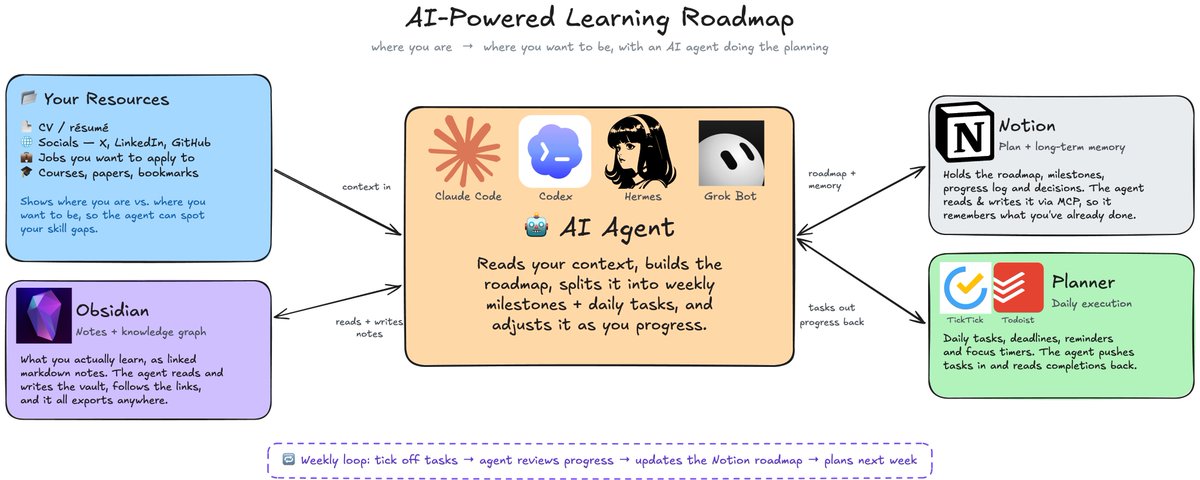
if you have too many interests, this 35 min Dan Koe video will reshape what you do with your curiosity:
>you have 10 interests
>everyone tells you “pick one”
>but specialists get replaced first by AI
>so you keep all 10 anyway
>do nothing with them
>you’re not lazy
>you just have no plan
>plans bring out clarity out of anxiety
>your 10 interests connect
>turns you into a unique combo
>that’s not easily replaceable


Nik retweeted

if i had 6 months to become an AI engineer from zero
i'd do this
Stage 1: the boring foundations
- learn: python, git, the terminal, http and json, basic sql, fastapi
- practice: build a cli tool that calls a public api and writes clean json to disk
- why: ai engineering is software engineering first, and every stage below assumes you can ship a working endpoint
Stage 2: llm app development
- learn: prompting, structured outputs with pydantic, tool calling, streaming, conversation state, token cost
- practice: build an invoice parser that returns a typed python object, then give a model 3 tools and let it pick
- why: this is the actual job, and most people skip straight past it to agents
Stage 3: rag, properly
- learn: embeddings, chunking, vector stores, metadata filtering, reranking
- practice: ingest 20 pdfs and ship an endpoint that returns a cited answer from the top 5 chunks
- why: most rag failures are retrieval failures, so whoever can debug retrieval gets paid
Stage 4: agents, workflows and evals
- learn: the agent loop, tool descriptions, state, retries, and when an agent is the wrong call
- practice: build one agent with no framework at all, just the api, 3 tools and a while loop
- why: a chain of 3 fixed calls beats an agent that might make 3 calls, and knowing which one you need is the senior part
Stage 5: deployment and reliability
- learn: docker, background jobs, auth, rate limits, tracing with langfuse, caching, cost control
- practice: containerize your rag app with a vector db and redis, then put a hard daily spend cap on it
- why: this is where most people stall, they can demo but they can't survive real traffic at 2am
Stage 6: pick one lane
- learn: product engineering, applied ml, or business automation
- practice: ship 2-3 projects a stranger can open and use without you explaining anything
- why: six months makes you dangerous in one direction, not average in three
you don't need to train models
you need to build systems on top of them, and that's what companies are actually paying for
i wrote the full version of this with every resource and link for each stage
so, if you're beginner and skipped this article 6 months ago, read below:


Nik retweeted

HOW TO BECOME A FORWARD DEPLOYED ENGINEER (53 MIN MASTERCLASS)
Some forward deployed engineers are getting PAID $1M+/year (kinda crazy, I know)
And I REALIZED almost nobody talks about HOW they do it in any detail. It's basically nowhere online.
So I asked someone who does it ALL DAY LONG for Fortune 500 companies to walk me through it, step by step. and he shares EXACTLY how he does it
youtube.com/watch?v=1a5HxU52…
Here's what I learned:
1. They start by listening, not building. They interview the people doing the work and let agents quietly read the company's data for a few weeks. The real process is almost always 3x longer than the one on paper.
2. They sort every step into four buckets: delete it, automate it with a simple rule, give it to an AI agent, or keep a human on it. A surprising amount ends up in the first bucket.
3. They build inside the tools the company already uses. Nobody has to learn a new app. When a human needs to sign off, it's just a Slack message.
4. They use the cheapest model that gets the job done. Most of this work doesn't need the most expensive AI.
5. They measure everything before and after, then come back 6 months later and prove it worked.
This + concrete client examples + way more on today's episode of @startupideaspod (thanks to @vasuman)
A full course pretty much on the topic aivalable to you 100% for free.
This episode is for ANYONE who wants to be a FDE or who wants to make their company AI-native by deploying agents.
Watch




Nik retweeted

Spent the weekend with Meta's @Muse, and they got a lot right.
- Every user gets their own VM.
- The agent never sees a password.
- A 2nd agent (Sentinel) has to approve anything that leaves the box.
- Every action is in the audit trail.
That's the most careful consumer agent sandbox I've used.
I don't know if folks realize but a VM for every user, at Meta scale, is kinda huge! It's never been done before where we simply provision a linux microVM for every single consumer.
We recently did this within @Cisco for over 80,000 of our employees. And now within our products as well as we start to scale it out to every single one of our users.
1/n


Nik retweeted

After co-inventing ChatGPT, I kept asking myself: why have superhuman chat models not led to AGI?
I’ve spent the last 2 years in stealth building a new way to train models (RLCD), and a new type of frontier AI model that we are releasing today: Jev
• 20-200x faster
• 40-400x cheaper (w/ output tokens free)
• Frontier composable intelligence optimized for decisions
AFAICT the shortest path to AI-based economic revolution
Nik retweeted

Our latest research paper explores the growing connection between AI and digital assets and explains why broad AI adoption may drive new demand, utility and applications across the digital asset economy. blackrock.com/us/individual/…


Nik retweeted

Jev Founder, Diogo Almeida (ex-OpenAI):
"The next era is not the Claude Code or Codex era, they are still part of the assistance era with human in the loop - JEV is what comes next for LLMs
x200 faster, x400 cheaper, 0 hallucination, no human in the loop - that's JEV, this is how LLMs will look like"
in 36-minute tech talk, Jev Founder explained why RLHF isn't a thing anymore and how modern LLMs will be built
this talk is worth more than a Stanford Machine Learning degree
watch today no matter what, then learn how to become a Jev Engineer in the article below

