

Fannie Mae and Freddie Mac Retirees and Families
Joined January 2025
- Tweets315
- Following195
- Followers611
- Likes8.5K






F2 retweeted

Bill Ackman called on the Trump administration to release Fannie Mae and Freddie Mac from conservatorship, warning that a Democrat-controlled government could weaponize the entities against Republicans bloomberg.com/news/articles/…

F2 retweeted

"It's absolutely politically critical for Fannie and Freddie to be released from conservatorship before the end of the Trump administration."
@BillAckman is bullish on $FNMA and $FMCC – here's why:
cnbc.com/video/2026/10/22/bi…

F2 retweeted

We welcome your focus. Now is the time to take further steps for release from conservatorship.
F2 retweeted

For 250 years, America has been the greatest nation on Earth — and with God’s grace, it will be for 250 more.
Happy Independence Day!
F2 retweeted

$FNMA $FMCC
@realDonaldTrump today on Air Force One when pressed on the Fannie Mae & Freddie Mac IPO:
"We’re thinking about an IPO for them…it's not a rush."
IMHO, if he wasn’t going to do it, I believe he would just say so.
There’s too much money to be made on all sides not to do it. But timing is everything.
GLTA
F2 retweeted
And Fannie and Freddie are stupidly cheap. Asymmetry at its best. They could be a 10X and it could happen soon.
F2 retweeted
A number of press reports have characterized our and other shareholders’ efforts on behalf of Fannie and Freddie (F2) as seeking a ‘gift’ or ‘handout’ from the government. We, the shareholders of F2, seek no such thing.
Hundreds of financial institutions were bailed out during the GFC by the U.S. Treasury. Nearly all of the financial institution bailouts during the GFC involved an injection of capital in the form of senior preferred stock by Treasury at an interest rate of 5%, plus warrants to acquire common stock in an amount equal to 15% of the face amount of the preferred with an exercise price at the then-current stock price of the rescued institution.
For example, Treasury’s preferred stock investment in Goldman Sachs was in an amount of $10 billion and, in addition, Treasury received warrants on $1.5 billion of GS' common stock at its then market price.
The bailout terms for F2 were materially more burdensome and expensive, with a higher interest rate and substantially more warrant coverage, than that of every other financial institution (other than those of AIG whose terms were similar). Despite the F2 bailouts’ massively more burdensome terms, shareholders are not complaining about the original terms.
Treasury invested $193 billion in F2 in the form of senior preferred stock (SPS), including funding for $2 billion of commitment fees, with a 10% coupon (twice that of the banks). Treasury also received warrants on 79.9% of both companies’ outstanding shares.
Fannie and Freddie have since repaid Treasury $301 billion, which includes interest on the SPS at a blended rate of 11.6%, an interest rate which is 160 basis points more per annum, and have returned the entire $193 billion of outstanding principal, $25 billion in excess of what was contractually owed. In summary, the F2 SPS has been fully repaid according to its original contractual terms plus an extra $25 billion.
Despite the fact that the SPS has been more than repaid in full, Fannie and Freddie have not accounted for these payments on their respective balance sheets, and the $193 billion of SPS remains an outstanding liability as if no principal payments had ever been made.
How can it be, you might ask, if indeed F2 have repaid $301 billion to Treasury when only $276 billion was due could there be any remaining balance of the SPS on the F2 balance sheets?
The answer relates to something called the ‘Net Worth Sweep (NWS).’
During the second term of the Obama administration, on August 12, 2012, two quarters after F2 returned to profitability, Treasury announced that it was unilaterally amending the terms of the SPS stock to provide that Treasury would take 100% of the profits of F2 each quarter in lieu of the 10% annual dividend rate. This was not a negotiated resolution with F2. It was a unilateral amendment of the original terms of the SPS that was done in bad faith.
The supposed rationale for the amended terms of the SPS was akin to the IRS garnishing the wages of someone who will never be able to pay the taxes that they owe. That is, the Treasury said F2 will never be able to pay the 10% coupon, let alone the SPS’ $193 billion principal balance, so it decided instead to ‘settle’ for 100% of F2’s profits forever.
In discovery, shareholders learned that the stated justification for the amendment was false. In mid 2012, the Obama administration had come to learn that both companies would soon be reversing tens of billions of reserves on their balance sheets as housing values had increased and the reserves taken during the GFC had been excessive. The NWS was instituted by Obama to forestall F2 from forever being able to recapitalize and be released from conservatorship. The NWS was not a ‘settlement’ for a lesser amount of future payments. It was the outright theft of the forever profits of both companies.
Never before or since has the government ‘swept’ 100% of the profits of any company, let alone a financial institution in conservatorship, a form of government intervention where the goal is rehabilitation of the institution, and where the hierarchy of corporate claims has always been respected.
The accounting for the NWS payments while it was in effect (until Secretary Mnuchin terminated the NWS in Trump’s first term) was also unusual. The NWS was treated by F2 as a quarterly adjustment to the dividend rate on the SPS such that the dividend amount owed was made equal to the after-tax profits of F2 for that quarter with no limitation.
In other words, regardless of the amount of profit F2 generated for the quarter – whether or not it was in excess of the original 10% annual dividend – the dividend payable under the NWS was made equal to the quarterly profit. The absurd terms of the NWS sweep therefore made it impossible for any partial or full repayment of the SPS to take place as every dollar paid to the Treasury on the amended terms of the SPS was considered a dividend payment, even if the amount was massively in excess of the original contractual SPS terms.
The absurdity of the NWS was made clear just two quarters after the NWS went into effect. Fannie Mae generated a profit of $59 billion in the first quarter of 2013, and the SPS dividend rate for that quarter was set at $59 billion so the entire amount was swept to the government, more than 10 times the contractual dividend rate.
I had the opportunity to discuss F2 and the NWS with Warren Buffett about a decade ago and he said that he “couldn’t believe what the government had done.”
In short, the shareholders of F2 are simply asking the government to respect the original and highly burdensome terms of the SPS. There is no dispute that Treasury has received more than the original 10% coupon and full repayment of principal of the SPS, that is, an extra $25 billion.
We and the millions of other shareholders of F2 are simply asking the administration to honor the original SPS terms and properly account for the $301 billion of payments, thereby eliminating the SPS liability from both companies’ balance sheets.
Shareholders have not asked for the extra $25 billion to be returned to the two companies. Treasury can decide whether to keep those funds or return them to the companies.
Accounting for the repayment of the SPS has other important implications. Namely, it is critically important that conservatorships respect the rule of law, in particular, the contractual terms of corporate instruments and the hierarchy of claims. Otherwise, no financial institution that gets into trouble will be able to raise rescue capital in the private markets.
Notably, the treatment of F2 in conservatorship explains why Silicon Valley Bank and other recent large bank failures since the GFC were unable to raise private capital and avoid government intervention or a forced sale to J.P. Morgan. If the government with the stroke of a pen during conservatorship can at a whim wipe out common and preferred shareholders, no one is going to step in to try to save a financial institution that gets into trouble, and only the top few banks will be possible rescuers of big banks that fail.
Furthermore, because of F2’s history, their reputation in the capital markets has been greatly damaged. F2 raised $22 billion of preferred stock in the year or so prior to conservatorship as the government pressed both companies to raise capital. Institutions were willing to invest billions of dollars of capital into both institutions before they failed because, based on all precedent conservatorships, the contractual terms of all financial instruments and the hierarchy of claims had been preserved. Unfortunately, in light of the precedent of the net worth sweep, no investor can be confident that they won’t be wiped out in a future conservatorship so none has been willing to take the risk.
Some have proposed that Treasury simply convert the SPS into junior preferred and common stock and massively dilute shareholders. Putting aside the potential legal challenges to this approach, the result will be that Treasury will at best own something approaching 95% of both companies rather than 79.9%.
While the government’s percentage ownership stake would be larger in the SPS conversion approach, the value of the government’s larger stake would be considerably lower as the companies would become un-investable. Who would invest in F2 alongside the government when they just wiped out the previous owners?
In the SPS conversion scenario, the government’s stake, at best, if it could be sold, would trade at a massively discounted valuation, well below the value of the government's stake if Treasury retained only its contracted for 79.9% stake and respected the original terms of the SPS. In other words, a slightly smaller ownership stake of much more highly valued companies would equate to considerably more value for Treasury and taxpayers.
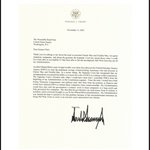
In a public letter to Rand Paul after his first term in November of 2021, President Trump recognized that the net worth sweep was theft from the shareholders of Fannie and Freddie. He wrote:
“Another Obama/Biden scam in legal trouble was when they allowed the Federal Housing Finance Agency (FHFA) to steal the retirement savings of hardworking Americans who had invested in Fannie Mae and Freddie Mac…The idea that the government can steal money from its citizens is socialism and is a travesty brought to you by the Obama/Biden administration. My Administration was denied the time it needed to fix this problem because of the unconstitutional restriction on firing Mel Watt. It has to come to an end and courts must protect our citizens.”
I couldn’t have said it better than President Trump.
Now that you have the time, Mr. President, let’s Stop the Steal!


F2 retweeted
Trump is asking bank executives for their pitches on monetizing mortgage giants Fannie Mae and Freddie Mac, including a major public offering of stock, sources say bloomberg.com/news/articles/…
F2 retweeted
Interesting. I will look into these Obama items, if available, as it relates to our Agency and the GSEs.

Matt Taibbi on why the Obama administration is trying to keep 11,000 documents sealed rol.st/1NjjA61

F2 retweeted

Over the course of the conservatorship, the GSEs paid over $301 billion back in dividends, fully repaying the initial federal investment on the original terms.

F2 retweeted

One glaring mistake, in a letter about Fannie & Freddie from Senate Democrats to Pulte, reminds us that almost NOTHING about the GSE conservatorship is what it seems, or withstands scrutiny. An explainer thread. 1/
banking.senate.gov/imo/media…
F2 retweeted
@carney @BreitbartNews. There are many inaccuracies here; please correct your article and reveal the TRUTH.
1. The Anti-Deficiency Act Does NOT Prohibit Deeming the Senior Preferred Repaid
Carney’s Claim:
“The Anti-Deficiency Act prohibits executive branch officials from spending or giving away federal resources without a congressional green light… This likely gives Congress the exclusive authority to dispose of federal assets, including the senior preferred shares.”
Why This Is False:
The Anti-Deficiency Act (ADA) was designed to prevent agencies from spending money not appropriated by Congress. It does not govern how the federal government accounts for repayments or restructures contractual claims arising from its investments in financial institutions.
The “disposal” of assets under the ADA refers to spending federal funds or giving away tangible property, not recognizing the economic reality of a debt investment that has been repaid many times over. Treasury’s “senior preferred” position is not an asset in the same sense as surplus property—it's a contingent equity claim, which is satisfied as cash flows return the investment and an appropriate rate of return.
Precedent: The government has repeatedly restructured or extinguished claims arising from emergency interventions (see AIG, GM, Citi) without new acts of Congress. Treasury had broad statutory authority under HERA to enter into and modify support agreements, including the authority to adjust, waive, or release its claims once the risk and original investment have been satisfied.
Delegated Authority: HERA (2008) explicitly gave Treasury and FHFA powers to “determine the terms and conditions” of support, and to “take such action as may be necessary” for the GSEs’ safety, soundness, and preservation of assets. Nowhere does it require subsequent congressional approval to deem a financial obligation repaid when the agreed terms have been exceeded.
Key Point:
Recognizing that over $300 billion has been repaid against a $191 billion original drawdown—with a double-digit IRR—does not “give away” taxpayer assets. It acknowledges that the terms have been satisfied, which is standard in finance and law. The anti-deficiency argument is a red herring.
2. Article IV, Section 3 of the Constitution Does NOT Bar Administrative Resolution
Carney’s Claim:
“Article IV, Section 3 likely gives Congress the exclusive authority to dispose of federal assets, including the senior preferred shares.”
Why This Is Misleading:
Article IV, Section 3 empowers Congress to “dispose of and make all needful Rules and Regulations respecting the Territory or other Property belonging to the United States.” However, Congress can (and routinely does) delegate authority to federal agencies to manage, sell, or modify federal property—including financial claims.
Delegation Established by HERA:
HERA granted FHFA and Treasury full statutory powers to enter into, modify, and resolve conservatorships. That’s why the government could issue and exercise warrants, sweep net worth, and even restructure principal claims as a matter of contract law.
Legal Precedent:
In the AIG, GM, and Citigroup bailouts, the U.S. Treasury routinely extinguished claims, wrote off assets, and converted preferred stakes to common equity—all through delegated authority, not by act of Congress.
Courts have consistently upheld such delegation where Congress has made clear statutory grants, as in HERA.
Key Point:
Congress has already authorized the means for these actions. FHFA and Treasury are acting within their delegated powers when they determine that obligations have been satisfied and contracts fulfilled—this is not an unconstitutional “disposal” requiring new legislative action.
3. Shareholder Base Is NOT Dominated by Hedge Funds—Majority Are Ordinary Americans
Carney’s Claim:
“The biggest winners of this huge write-off of taxpayer assets would be billionaire hedge fund managers… handing out windfalls for billionaire financiers in New York City.”
Why This Is False:
Main Street Dominance:
The overwhelming majority of Fannie Mae and Freddie Mac shareholders are individuals, retirees, teachers, first responders, and working families—not hedge funds. This has been demonstrated in SEC filings, platforms like Fintel, and by amicus briefs and petitions from large groups of retail investors.
Hedge Fund Myth:
Hedge funds are visible because of their size and activism, but collectively own a minority of the outstanding shares.
Actual “Main Street” investors have endured years of profit sweeps, contract breaches, and value destruction. They stand to benefit most from fair treatment.
Key Point:
This is not about hedge funds—it’s about millions of ordinary Americans seeking a fair return after a 16-year conservatorship and more than $300 billion in remittances to taxpayers. The narrative of “windfalls for billionaires” is a political talking point, not a fact.
Additional Points:
1. Taxpayers Maximize Value with Shareholders:
Taxpayers have received over $100 bn on their investment—a return unparalleled by any other bailout in history. The government still holds 79.9% warrant coverage, which—if restored to proper equity value—would further boost taxpayer returns by an additional $250 bn
2. Safety and Soundness Is Not Threatened:
At a 2.5% capital requirement (per stress test results), Fannie and Freddie could withstand losses five times greater than the 2008 crisis.
Arbitrarily punitive capital requirements harm affordability for families and are not justified by empirical risk.

Full article here: breitbart.com/economy/2025/0…

F2 retweeted

Andre,
SCOTUS said the APA claims don’t apply because FHfA can act in public interest. But, the proper avenue for a SCOTUS hearing on this would be the takings case- taking private property for no compensation. That is what the judges suggested themselves!
Further, judge Lamberth in a 95% dem jurisdiction awarded nearly $1bn of damages and interest to the shareholders from a jury trial (8-0) based on unfair dealings contract clause indicating the private shareholders couldn’t have expected the net worth sweep! Activating the theft again would be grounds for a similar lawsuit with larger damages models.
The Gov’g forcefully “bailed out” Fannie/Freddie by writing off Deferred Tax Assets under the assumption that real estate prices would not recover from the 2008 low. The bailout terms were designed to be as punitive as possible and generated over $300bn on $192bn injected 11%+ IRR. Now, the Gov’t can generate an additional $200bn+ from warrant conversion/ commons sale. This is by far the most profitable Gov’t investment from the 2008 crisis.
Anyone saying private gains/social losses is disingenuous because the gains have been swept to the Gov’t and the losses forced upon the shareholders. All we are asking for is a return to the market based system that made America so successful, not maintaining the socialist approach to the GSEs undertaken by Obama and then Biden. @pulte

Bill, you can’t claim to want “rule of law” and then cry “coercion” when courts enforce it.
The GSEs needed a $191B bailout. That’s not a “gun to the head,” that’s insolvency. When you're broke, the terms aren't optional.
The Net Worth Sweep was legal — upheld by multiple courts, incl. SCOTUS in Collins v. Yellen (2021). FHFA, as conservator, had full authority. That’s the law. You knew it when you bought in.
You made a risky bet on a political outcome. It didn’t pay off. That’s not expropriation — it’s capitalism.
#FannieMae #FreddieMac #NetWorthSweep #PershingSquare #FinanceTwitter #CaveatEmptor
@Pershing @PershingSqFdn @AOC @stephaniekelton @mehdirhasan @mtaibbi @ewarren @FoxNews
F2 retweeted
Director @pulte,
Thank you for your hard work on improving federal housing for Americans.
On behalf of many thousands of American families that are shareholders of Fannie Mae and Freddie Mac, we respectfully submit this letter. This letter, along with a request for a meeting in DC, has been submitted via email and regular mail.
In a recent interview, you said that you are willing to listen to anyone. As the majority owners of the outstanding common shares, hardworking Americans deserve a voice.
Thank you for your consideration.
- Family shareholders of Fannie Mae and Freddie Mac
$FNMA $FMCC


F2 retweeted
They will get Aaa ratings. The most likely impact is no impact or a slight improvement in spreads.
F2 retweeted
It is important for your viewers to know:: The majority of holders of Fannie Mae and Freddie Mac common shares are retirees, taxpayers, and families building wealth and pursuing the American dream—not hedge funds.
As @POTUS pointed out in his letter: “Another Obama/Biden scam in legal trouble was when they allowed the Federal Housing Finance Agency (FHFA) to steal the retirement savings of hardworking Americans who had invested in Fannie Mae and Freddie Mac…The idea that the government can steal money from its citizens is socialism and is a travesty brought to you by the Obama/Biden administration.”
$FMCC $FNMA

F2 retweeted

If the GSE conservatorships were to end, would that lead to even lower ratings? Not necessarily, said @moodysratings Warren Kornfeld. They’ll remain SIFIs at the center of the U.S. housing/mortgage markets; it’s unlikely the government would let them fail. insidemortgagefinance.com/ar…
F2 retweeted

The GSE conservatorship has gone on for far too long. I agree with @POTUS that the government should sell its stake in Fannie Mae and Freddie Mac to bring in more private capital. The funds can be used to pay for middle class housing!

