

I'm a theologian, tinkerer, and I get followed by scammers, bots, and fake people pretending to be the real person.
Joined April 2017
- Tweets4.9K
- Following325
- Followers767
- Likes76K


All these turkeys that walked and waded by are now all loudly roosting in the trees along the north hill shoreline. Channeling my Francis of Assisi while playing toe-tappers.
With winter approaching, I continued taking afternoon breaks from “doing” theology to build slash piles. It sure is magnificently pretty.


It is just a stunning Sunday afternoon in north-central Minnesota! I’m up on the north end trimming up trees which is a thing that I love doing—even if I’m cripped up and need to take an excessive number of breaks.


Having finished up my 2025 taxes today (they’re due tomorrow if you filed an extension), I went out to my garage and riveted on a joke to one of my garage cabinets. You either get it, or you don’t.

A point of theology Calvinist don't know about:
Both Calvinists and Wesleyan-Arminians like myself hold to the doctrine of total depravity. The difference between Calvinism and Arminianism is that the grace in Wesleyan-Arminianism is BOTH resistible and effectual.
When grace is embodies and acted upon, the person is saved. But what does rejected grace do?
The grace that God gives to all persons either:
1) Glorifies the Lord through the good deeds, thoughts, and actions that are reflective of His image and reveal that he is the source of all that is good.
2) Or reveals our Lord's genuine, constant love and mercy toward those who ignored and rejected his ministry of grace throughout their lifetimes.
As such, at the Judgment Seat, the grace the Lord rained upon all persons ultimately either:
1) Glorifies the Lord in and through a people whose thoughts and actions reflect the image of God; or,
(2) the grace that was given upholds the justice and righteousness of condemnation, where the condemned stand self-convicted of the fact that the Lord continually reached out to them to draw them unto himself but they rejected all of his servants and even rejected his continual inward witness to the bitter end.
When resisted to the bitter end, the grace received throughout one's earthly life is not an empty footnote—it becomes the very basis of condemnation.
At the Judgment Seat, the condemned will stand entirely self-convicted. The historical reality of God’s grace—the repeated, inward promptings of the Spirit, the quiet convictions, the external witnesses—will stand as an irrefutable testament that the Lord genuinely, lovingly, and mercifully reached out to draw them to Himself to the bitter end. Their condemnation is rendered flawless because they are exposed as individuals who actively chose to starve in the presence of an open banquet.
Those who resist the grace so lovingly provided spend their lifetimes building mansions they will never occupy and planting vineyards they will never harvest. They race toward judgment under the terrible weight of a self-imposed blindness. Thus, both in salvation as well as in judgment, resistible grace is effectual in Wesleyan-Arminian theology.
🤖 Made with AI

"Giving the Gospel to a fallen soul without an internal, enabling work of the Spirit is like flashing a brilliant light into the eyes of a blind man. The problem is not the power of the light; it's the damaged condition of the faculties."
In the conclusion of my two-part series, I expose the central flaw in Provisionism's external-only model of grace. Christianity is not a religion where dead men reach out to know God on their own natural steam—it is the Father graciously working His way to us.
My full defense of a living pneumatology over rationalistic soteriology is linked below. 🧵👇
@GraftedTheology @ArminianSociety @NickQuient
@rootcausesleuth @_DHDS @CherylSchatz @RisingDisciples @gowdy_luke @w_bitterman @Bombasotta @Whosoeverwills @GoWithJordan_ @M_Christianity @DoctrinalPossum @Soteriology101 @Ainigma777 @ProvisionistP @theojunkiedan @YinKysmileS @cum_granosalis @DPGBehler @Fletch1171 @dhanabarger @HwsEleutheroi @HarwoodAdam
xitter.cf/HomeAndHandy/status/21…


Question: what is a good, red-letter, gold-leaf, bonded-leather, journaling Bible?
Also, what is some good movable tape for holding notes in rice paper Bible pages without wrecking the pages to move the notes and then place the note back in when reading the text?

By rejecting both the Calvinist view (Internal/Irresistible) and the Arminian view (Internal/Resistible Prevenient Grace), Provisionism has painted itself into a corner. To maintain that humanity can respond to the Gospel without a prior internal work of the Spirit, they have to rely heavily on a highly rationalistic, evidence-based model of faith.
This is exactly why myself and other observers have noted a "theological drift" or constant recalibration since 2016 publication of Anyone Can Be Saved: A Defense of "Traditional" Southern Baptist Soteriology. When pressured on the charge of Pelagianism or Semi-Pelagianism (the idea that humans can take the first step toward God entirely on their own power), Provisionists have had to constantly refine their language. They want to claim that the Spirit "supernaturally woos" us, but because they refuse to allow that wooing to be an internal, metaphysical enabling, they are forced to define "wooing" as the external beauty and logical weight of the Gospel message itself.
Provisionism's hardened rejection of the Holy Spirit's ministry of enabling grace—which involves the Holy Spirit striving and working internally in us before repentance and faith in order to metaphysically free our minds from the curse and bondage that resulted from the Fall of Adam—simply makes for bad soteriology.
As I shared elsewhere, my prayer for Provisionism is that it eventually comes around on the subject of the Holy Spirit being intimately tied to supernatural grace—grace that metaphysically and internally prepares unbelievers to hear and respond to the Gospel—and, in doing so, returns to orthodoxy on the subject.

Picking up where I left off yesterday on Provisionism. I've compiled my thoughts into a formal article examining how a hyper-fixation on defeating Calvinism can inadvertently cost us a historic, personal understanding of the Holy Spirit's internal grace.
@GraftedTheology @ArminianSociety @NickQuient @rootcausesleuth @_DHDS @CherylSchatz @RisingDisciples @gowdy_luke @w_bitterman @Bombasotta @Whosoeverwills @GoWithJordan_ @M_Christianity @DoctrinalPossum @Soteriology101 @Ainigma777 @ProvisionistP @theojunkiedan @YinKysmileS @cum_granosalis @DPGBehler @Fletch1171 @dhanabarger @HwsEleutheroi
xitter.cf/HomeAndHandy/status/21…

I forgot to add Adam Harwood to this list. @HarwoodAdam
xitter.cf/HomeAndHandy/status/21…
Provisionism's hyper-fixation on defeating Calvinism sparks a major over-correction. Reducing grace to external illumination risks losing the Spirit's intimate rescue mission. My latest paper explores this deep pneumatological crisis in modern theology.
The trouble with privately built echo chambers is dissenting voices that could serve to educate (even amid challenges) are discounted or banished, leaving the chamber with only the sound of its own voice.
Sadly, theologically astute individuals often build echo chambers because they don't thoughtfully interact with the rest of the Body of Christ by becoming familiar with other Christian primary sources. Herein, highly intelligent individuals frequently fall into the intelligence trap, using their superior argumentative skills to defend a single viewpoint rather than exploring alternative perspectives. Driven by a need to appear clever and maintain intellectual superiority, they often avoid the risks of creative thinking in favor of the quick, easy pay-off of attacking others' ideas.*
Speaking of opening up discussion, my view of Provisionism has conditionally evolved, moving the theological position away from Semi-Pelagianism toward orthodoxy.
But I'd like confirmation, and to move the discussion forward, classical Wesleyan-Arminians like myself need to be supplied a definition of grace as understood by Provisionism as well as how grace is or is not tied into the role of our Lord's Spirit in salvation as well as what is the Holy Spirit's role?
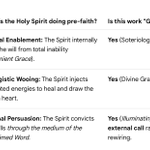
Unpacking the role of grace in light of the Holy Spirit: specifically, what is going on in the unbeliever before faith? I'm told that the Holy Spirit is involved, but this involvement IS NOT considered to be grace by Provisionists?
To my theological ear, this sounds like a completely different definition of grace than the one applied by almost everyone else across the broader theological trajectory.
The crux is this: By defining grace as external illumination rather than internal enablement, Provisionism shifts the theological conversation completely away from how the Holy Spirit unlocks a dead heart. For example: the hearing of the Gospel is an instrumental cause which the Holy Spirit uses to illuminate the mind and soften the heart, but this is not called grace?
From my non-Provisionist perspective, this model depersonalizes our Lord's involvement, obscuring His role as a divine Person who interacts with us situationally, dynamically, and intimately throughout the process of salvation.
Since I don't believe Provisionists are intentionally trying to depersonalize our Lord's involvement, why the move away from a traditional definition of grace? What is the point? Is it that they don't want to acknowledge that the supernatural God who created all things also works to supernaturally woo the entire human race?
Especially in light of the fact that every conversational definition of humanity's sin nature sounds like a "dead ringer" for the Eastern Orthodox doctrine of Ancestral Sin,** the view that I hold. Herein Provisionism attempts to build an Eastern-style anthropology without an Eastern-style view of grace.
Eric Landstrom
Footnotes:
* You can read more about in the Intelligence Trap in Edward de Bono's I Am Right, You Are Wrong.
** Both Eastern Orthodoxy and Provisionism teach that we do not inherit Adam's personal guilt. Instead, we inherit the consequences of his sin: mortality, physical corruption, brokenness, and a severe exposure to temptation. We sin because we are born into a dying world, and not because our moral engine was fundamentally rewritten to be incapable of choosing good over evil. For those noodling along, I mapped out the core concepts of Ancestral Sin in an article on the Society of Evangelical Arminians website.
Loss of Fellowship: Adam was sustained by divine grace (or "nearness"); when he sinned, he broke fellowship with God (the source of that grace or nearness) and consequently became mortal.
Mortality over Guilt: Sin and death entered the world as a direct result of losing this divine communion.
The Condition of Descendants: Because Adam fell into a distancing, mortal, ungraced state, his children are born into that same physical mortality—meaning humanity faces physical death and an innate inclination toward sin, rather than being legally condemned for Adam’s personal crime at birth.
Atonement and Accountability: Through prevenient grace (the grace of God that goes before human action) and the universal efficacy of Christ's atonement, individual accountability is maintained, and people are held responsible for their own actual sins rather than an inescapable burden of inherited guilt.
xitter.cf/Soteriology101/status/…
@GraftedTheology @ArminianSociety @NickQuient @rootcausesleuth @_DHDS @CherylSchatz @RisingDisciples @gowdy_luke @w_bitterman @Bombasotta @Whosoeverwills @GoWithJordan_ @M_Christianity @DoctrinalPossum @Soteriology101 @Ainigma777 @ProvisionistP @theojunkiedan @YinKysmileS @cum_granosalis @DPGBehler @Fletch1171 @dhanabarger @HwsEleutheroi

Dr. White again critiqued me and Provisionism, this time over an article I reposted from Shawn Willson that White claimed entails open theism.
Ironically, the line he flagged is literally the opposite of open theism. Open theism (as White understands it) says God does not know future free choices. Willson’s point assumes the reverse: if Judas or Pilate had repented, God would already have known and arranged the cross through someone else. That is exhaustive knowledge of what free agents would do, including in circumstances that never occur. No open theism required. 🤷♂️
William Lane Craig, and others, have long said this about Judas. Prophecy says Judas will betray Jesus; it does not say he must. Had Judas freely refrained, Jesus would not have prophesied the betrayal, and God’s foreknowledge would have been of that other choice. Craig calls these backtracking counterfactuals: the past belief tracks the future act; it does not lock it in. Plantinga and others who reject open theism make the same move while still saying the agent could have done otherwise. Surely White knows this. 🤔
Scripture already speaks this way, so what is Willson’s crime?
1 Samuel 23:11–13: David asks whether the men of Keilah will hand him over if he stays. God says they will. David leaves, and they never do. God knew a free choice that was never made.
Also, Mordecai tells Esther, “If you remain silent at this time, relief and deliverance will arise for the Jews from another place, but you and your father’s house will perish” (Esther 4:14). He is sure God will preserve His people. He is just as sure Esther might not be the one He uses.
The “if” only works if her silence is a real option. Speak, and she may be the means. Stay quiet, and deliverance still comes, but she and her house perish. God’s purpose stands either way. The person in the story does not. That is the same conditional the Willson article used with Judas and Pilate: the end is secure, the instrument is not locked in. And again, none of this requires open theism.
Mordecai is not saying God is waiting to find out what Esther will do. He is saying that if she had refused, God would have known and gone another way.
So “Judas could have done otherwise, and God would have known it and still accomplished the cross” is ordinary conditional knowledge. Calling that open theism shows the critic has not thought these matters through.

I was asked to jump in on a live stream with self-identified “White Nationalists” (of which I am not one). Although unprepared and about as far away from white nationalism as a guy can possibly be, our conversation centered on Jews, with my defending the second temple Jewish worldview in the context of the New Testament and the beginnings of banking.
While I think our conversation was progressing well, my aging iPhone overheated and I lost my microphone. Perhaps another time.

I just found out from my best childhood friend, Todd, that his sister and my longtime childhood friend, Jan, was shot seven times in last month’s Minneapolis apartment mass shooting. Jan may never regain the use of her left arm and has suffered parts of her intestines being removed. She was just readmitted into the hospital for malnutrition. Jan needs our prayers for healing.
@rootcausesleuth please put Jan on your Monday prayers list. Thank you.
