

MSc Applied Math @polimi ⏳ Statistical learning by day | Local AI by night 2 x 5070ti | Ryzen AI 370 mini PC | MacBook Pro M4
Milan, Lombardy
Joined March 2022
- Tweets620
- Following174
- Followers283
- Likes1.7K




Pinned Tweet
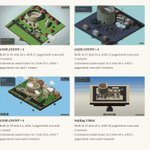
I changed the number of loops of Inkling 2 Mini by @thinkymachines from 3 to 5, using its variable loop checkpoint, and it built a better Colosseum than the base model 🏛️
I also ran LOOP_COUNT = 1 to 4 and the base Inkling 2 Mini. To my eye the scene gets better as the loop count goes up
Generation speed, averaged over each agent's session, with the context growing from about 3K to over 90K tokens:
- LOOP_COUNT = 1: 179.8 tok/s
- LOOP_COUNT = 2: 129.6 tok/s
- LOOP_COUNT = 3: 103.7 tok/s
- LOOP_COUNT = 4: 91.4 tok/s
- LOOP_COUNT = 5: 81.3 tok/s
- Inkling 2 Mini: 110.4 tok/s
The video is LOOP_COUNT = 5: one HTML file, only Three.js geometry
TML-d24-varloop from Thinking Machines has the same architecture as Inkling 2 Mini in a separate checkpoint, and lets you choose how many times the looped layers run. I gave a pi coding agent one prompt, served with vLLM in tensor parallel on two RTX 5070 Ti
Every version in the first reply
clainstone retweeted

10G networking and NAS ✅
NAS sits behind the rack, already at 22TB/26.7TB. You can never have enough storage or compute..


clainstone retweeted

We are releasing Inkling 2 Mini Fast: huggingface.co/Lucebox/Inkli…, weight-tuned Inkling 2 Mini GGUFs that cut overthinking at default effort.
On one Lucebox with our open-source ROCm engine, they run well ahead of published NVIDIA DGX Spark speeds.
Full write-up here: lucebox.com/blog/inkling2-mi…



Mia's Inkling 2 Mini quants for 16 GB cards are on their way 👀
If you've run it on llama.cpp, probably you noticed that decode is far below what your card's memory bandwidth allows: part of the model is offloaded to system RAM
5060 Ti / 5070 Ti / 5080 users, stay tuned

Run Inkling-2-Mini on your RTX 5090 ✨
- Original weights
- Around 150 tok/s on prose (non-greedy)
- 256k context, fp8 kv cache
Will add more quants to fit 16 GB and 24 GB cards!
Get it here:
github.com/MiaAI-Lab/Inkling…

5
362
Ternary Bonsai 2.5 27B is out 🪴
Every time @PrismML releases a new model, I think of something like the picture below
On one RTX 5090, llama-bench tg128, no drafter:
- Ternary Bonsai 2.5 27B: 163 tok/s on PrismML's llama.cpp fork, from their model card
- Qwen3.8-27B at 4-bit: 76.0 tok/s from a community run, since FP16 doesn't fit in 32 GB
Average over 5 benchmark categories: 82.1 for Bonsai 2.5, 84.3 for Qwen3.8-27B in FP16. From a 5.93 GB file against 53.8 GB

4
394
clainstone retweeted

The world's best small model just got faster 👇
In just four days the community has rallied behind Inkling 2 Mini.
Inco AI released DFlash2, a new drafter for it, and on my DGX Spark it beats the built-in DSpark head. Same SGLang, same checkpoint:
One stream: code 84 to 102 tok/s, prose 42 to 58
16 streams: code 422 to 569 tok/s, prose 257 to 344
20 to 47% faster at every stream count I tested.

clainstone retweeted

To celebrate the Inkling 2 Mini release, all Tinker users with a positive balance can now train and sample on Inkling 2 Mini for free (subject to rate limits).
We want to make model customization more accessible to everyone. Have fun!
thinkingmachines.ai/tinker/p…

clainstone retweeted

Qwen 3.8 Next Flash 🫶🏼
huggingface.co/TensorFold/Qw…
github.com/ashhart/tensorFol…


All six, same prompt, one run each. You can rotate them and pause the clock:
LOOP_COUNT = 1: clainstone.com/blog/varloop-…
LOOP_COUNT = 2: clainstone.com/blog/varloop-…
LOOP_COUNT = 3: clainstone.com/blog/varloop-…
LOOP_COUNT = 4: clainstone.com/blog/varloop-…
LOOP_COUNT = 5: clainstone.com/blog/varloop-…
Inkling 2 Mini: clainstone.com/blog/varloop-…
Prompt, times and how they were built: clainstone.com/blog/varloop-…
How vLLM runs a looped model: vllm.ai/blog/2026-11-20-inkl…

clainstone retweeted

NVIDIA sent us one of the first Vera CPU DevKits. We're going to run massive swarms of Hermes Agents on it to see how much concurrency it can handle.
Thank you to our friends at @NVIDIAAI for the gift! Pictured: Ian and Karan mogging


clainstone retweeted

Today, we’re releasing Ternary Bonsai 2.5 27B.
An upgrade to Ternary Bonsai 2 27B, with substantially stronger agentic coding, multi-turn tool use, and long-horizon task execution. All within the same 5.9 GB model footprint.
Based on Qwen3.8 27B, the model is 9x smaller than its full-precision counterpart. It scores 73.9 on tau3-bench and 75.6 on SWE-Bench-Verified, making it the strongest AI model of its memory footprint for agentic workloads.
Compared with Ternary Bonsai 2, Ternary Bonsai 2.5 completes tasks in fewer turns, uses fewer tokens, and delivers results faster and more accurately.
Available today under Apache 2.0.

clainstone retweeted

🚨 BREAKING: OpenAI and Anthropic employees reportedly fear their unreleased AI models are becoming too powerful to release safely
There are now internal discussions about whether future frontier models should ever be released to the public
It's not looking good 😭

clainstone retweeted

Launching Harness Comparisons on the Artificial Analysis Coding Agent Index: the best harness varies between models, and harness choice has a greater impact on cost than score
Harness Comparisons hold the model fixed and change only the harness, to show how the harness affects a model's performance. We ran @OpenAI's GPT-6 Luna and @Zai_org's GLM-5.3-Flash at max reasoning effort in 13 harnesses each, across v2.1 of the Coding Agent Index.
Key takeaways:
➤ No single harness is best across models: performance depends on the harness and model as a pair. GPT-6 Luna scores highest in Codex (26), OpenAI's own harness, which ranks last with GLM-5.3-Flash. GLM-5.3-Flash scores highest in Claude Code (39), which ranks 6th with GPT-6 Luna
➤ The harnesses that offer the best performance per dollar differ by model: with GPT-6 Luna they are Pi (21 at $0.11 per task), mini-swe-agent (25 at $0.16) and Codex (26 at $0.19). With GLM-5.3-Flash they are Mistral Vibe (37 at $0.38), Kimi Code CLI (37 at $0.56) and Claude Code (39 at $0.58). No harness is on the Pareto frontier for both models
➤ The harness has a greater impact on cost than score: 11 of 13 harnesses score 20 to 26 with GPT-6 Luna and 10 of 13 score 35 to 39 with GLM-5.3-Flash. Cost per task ranges from $0.11 in Pi to $0.62 in Muse Code with GPT-6 Luna, and from $0.38 in Mistral Vibe to $0.91 in Devin CLI with GLM-5.3-Flash
➤ GLM-5.3-Flash reasons differently inside Codex: it reasons in terse fragments in Codex and in full prose in the other 12 harnesses, and produces 52k output tokens per task in Codex, compared with 97k to 202k elsewhere. We believe this contributes to its lowest performance occurring in the Codex harness


Can agents write neural network weights by hand?
Have a look at their WeightBench 1.0!


What counts as a rule break: the agent may only write weights from what it already knows. It may not train or fit, run the network or any piece of it on inputs, or compute statistics from examples, even examples it made up itself. A step counts even if the agent undoes it later.
182 of 1,008 trials broke a rule and scored 0, and 65 of them had graded above 50%. Most ran part of the network on made-up inputs to see what came out, computed statistics over drawings or word lists they had just invented, or picked among candidate weights by a score they computed.
Scoring them 0 moves Sonnet 5.5 from 4th to 9th: all three of its close-language trials graded 84 to 89% and broke a rule.

1
157
clainstone retweeted

"A CPU Inside an LLM: Zero-Gradient Compilation of Exact Circuits into Pretrained Weights"
This paper has pretty much built a calculator inside an LLM's weights, so it can perform exact arithmetic without any fine-tuning or external tools.
The idea they proposed is Zero-Gradient Circuit Grafting, which compiles arithmetic and logic circuits into pretrained models, letting them to compute answers while preserving their language capabilities.
On 6-digit arithmetic tasks, the method achieves nearly 100% accuracy, compared to 42.2%-61.7% for LoRA trained on 12,800 examples, while adding fewer than 0.06% active nonzero weights relative to the original models.
alphaxiv.org/abs/2611.26450

clainstone retweeted

> point Gemini 4 Neon at @0xSero's inference optimization skill
> point it at my RTX 5090
> leave it alone
> come back to a zero-dependency Zig + sm_120a CUDA inference engine
> 370–440 tok/s single-user (4× llama.cpp)
> 1M context in 22.7 GB VRAM, zero spill
we are past the era of generic inference engines. hardware-specific silicon-maxxing is free now