

MSc Applied Math @polimi ⏳ Statistical learning by day | Local AI by night 2 x 5070ti | Ryzen AI 370 mini PC | MacBook Pro M4
Milan, Lombardy
Joined March 2022
- Tweets620
- Following174
- Followers283
- Likes1.7K




clainstone retweeted

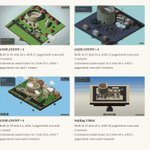
10G networking and NAS ✅
NAS sits behind the rack, already at 22TB/26.7TB. You can never have enough storage or compute..


clainstone retweeted

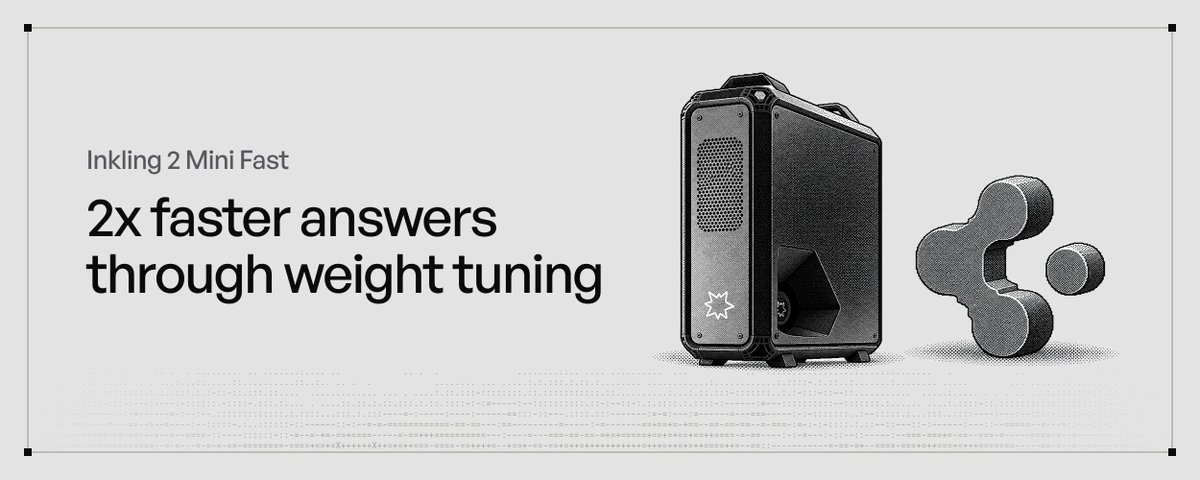
We are releasing Inkling 2 Mini Fast: huggingface.co/Lucebox/Inkli…, weight-tuned Inkling 2 Mini GGUFs that cut overthinking at default effort.
On one Lucebox with our open-source ROCm engine, they run well ahead of published NVIDIA DGX Spark speeds.
Full write-up here: lucebox.com/blog/inkling2-mi…


clainstone retweeted

The world's best small model just got faster 👇
In just four days the community has rallied behind Inkling 2 Mini.
Inco AI released DFlash2, a new drafter for it, and on my DGX Spark it beats the built-in DSpark head. Same SGLang, same checkpoint:
One stream: code 84 to 102 tok/s, prose 42 to 58
16 streams: code 422 to 569 tok/s, prose 257 to 344
20 to 47% faster at every stream count I tested.

clainstone retweeted

To celebrate the Inkling 2 Mini release, all Tinker users with a positive balance can now train and sample on Inkling 2 Mini for free (subject to rate limits).
We want to make model customization more accessible to everyone. Have fun!
thinkingmachines.ai/tinker/p…

clainstone retweeted

Qwen 3.8 Next Flash 🫶🏼
huggingface.co/TensorFold/Qw…
github.com/ashhart/tensorFol…


clainstone retweeted

NVIDIA sent us one of the first Vera CPU DevKits. We're going to run massive swarms of Hermes Agents on it to see how much concurrency it can handle.
Thank you to our friends at @NVIDIAAI for the gift! Pictured: Ian and Karan mogging


clainstone retweeted

Today, we’re releasing Ternary Bonsai 2.5 27B.
An upgrade to Ternary Bonsai 2 27B, with substantially stronger agentic coding, multi-turn tool use, and long-horizon task execution. All within the same 5.9 GB model footprint.
Based on Qwen3.8 27B, the model is 9x smaller than its full-precision counterpart. It scores 73.9 on tau3-bench and 75.6 on SWE-Bench-Verified, making it the strongest AI model of its memory footprint for agentic workloads.
Compared with Ternary Bonsai 2, Ternary Bonsai 2.5 completes tasks in fewer turns, uses fewer tokens, and delivers results faster and more accurately.
Available today under Apache 2.0.

clainstone retweeted

🚨 BREAKING: OpenAI and Anthropic employees reportedly fear their unreleased AI models are becoming too powerful to release safely
There are now internal discussions about whether future frontier models should ever be released to the public
It's not looking good 😭

clainstone retweeted

Launching Harness Comparisons on the Artificial Analysis Coding Agent Index: the best harness varies between models, and harness choice has a greater impact on cost than score
Harness Comparisons hold the model fixed and change only the harness, to show how the harness affects a model's performance. We ran @OpenAI's GPT-6 Luna and @Zai_org's GLM-5.3-Flash at max reasoning effort in 13 harnesses each, across v2.1 of the Coding Agent Index.
Key takeaways:
➤ No single harness is best across models: performance depends on the harness and model as a pair. GPT-6 Luna scores highest in Codex (26), OpenAI's own harness, which ranks last with GLM-5.3-Flash. GLM-5.3-Flash scores highest in Claude Code (39), which ranks 6th with GPT-6 Luna
➤ The harnesses that offer the best performance per dollar differ by model: with GPT-6 Luna they are Pi (21 at $0.11 per task), mini-swe-agent (25 at $0.16) and Codex (26 at $0.19). With GLM-5.3-Flash they are Mistral Vibe (37 at $0.38), Kimi Code CLI (37 at $0.56) and Claude Code (39 at $0.58). No harness is on the Pareto frontier for both models
➤ The harness has a greater impact on cost than score: 11 of 13 harnesses score 20 to 26 with GPT-6 Luna and 10 of 13 score 35 to 39 with GLM-5.3-Flash. Cost per task ranges from $0.11 in Pi to $0.62 in Muse Code with GPT-6 Luna, and from $0.38 in Mistral Vibe to $0.91 in Devin CLI with GLM-5.3-Flash
➤ GLM-5.3-Flash reasons differently inside Codex: it reasons in terse fragments in Codex and in full prose in the other 12 harnesses, and produces 52k output tokens per task in Codex, compared with 97k to 202k elsewhere. We believe this contributes to its lowest performance occurring in the Codex harness

clainstone retweeted

"A CPU Inside an LLM: Zero-Gradient Compilation of Exact Circuits into Pretrained Weights"
This paper has pretty much built a calculator inside an LLM's weights, so it can perform exact arithmetic without any fine-tuning or external tools.
The idea they proposed is Zero-Gradient Circuit Grafting, which compiles arithmetic and logic circuits into pretrained models, letting them to compute answers while preserving their language capabilities.
On 6-digit arithmetic tasks, the method achieves nearly 100% accuracy, compared to 42.2%-61.7% for LoRA trained on 12,800 examples, while adding fewer than 0.06% active nonzero weights relative to the original models.
alphaxiv.org/abs/2611.26450

clainstone retweeted

> point Gemini 4 Neon at @0xSero's inference optimization skill
> point it at my RTX 5090
> leave it alone
> come back to a zero-dependency Zig + sm_120a CUDA inference engine
> 370–440 tok/s single-user (4× llama.cpp)
> 1M context in 22.7 GB VRAM, zero spill
we are past the era of generic inference engines. hardware-specific silicon-maxxing is free now
clainstone retweeted
An internal Claude model just found a proof of the algebraic analogue of P vs NP, known as Valiant’s conjecture
Claude is credited as the author of the 70-page paper and the Lean proof passed automated checks.
If you remember the determinant of a 2×2 matrix, it’s ad − bc. Change it to ad + bc and you get the “permanent.” The same idea works for larger matrices. Both expressions grow to billions of terms by the time you reach a 13×13 matrix, yet the determinant has a shortcut that lets you skip writing them all out.›
Could there be a shortcut like that for the permanent? The paper claims that over the real numbers, even the best possible sequence of additions and multiplications eventually takes more steps than any fixed polynomial in the matrix size.
Read here: alphaxiv.org/abs/2611.vp-vnp…

clainstone retweeted

I built a tiny Dreamer-inspired world model from scratch.
It has ~550k parameters and learns to play video games by practicing inside its own imagination.
write up + implementation 👇
clainstone retweeted

Gemini 4 Neon recreated Alan Turing’s 1936 study at @Cambridge_Uni in interactive 3D.
Using archival photos in @Antigravity, the model built Room X.8 at King’s College with a running Universal Turing Machine.
clainstone retweeted
GLM took almost 4 times as long per decision as Inkling, and still won this strategy game.
I put Inkling 2 Mini on one RTX 5090 against GLM-5.3-Flash on four DGX Sparks and gave both one try. The medians are 4.0 seconds for Inkling and 15.4 for GLM.
GLM won by destroying Inkling's town center and every building that trains units, after 16:28 of game time.
Inkling made 279 decisions to GLM's 106. In the biggest fight, 90 seconds and 80 kills, Inkling lost 61 units and GLM 19.
Inkling 2 Mini by Thinking Machines ran as the NVFP4/MXFP8 checkpoint on vLLM (official image, build 0.1.dev25855, one small cache patch of ours). One RTX 5090 with 32 GB, 93K window, thinking on.
GLM-5.3-Flash XSFP4 ran on TensorFold 1.3.3 with TP=4. Four DGX Sparks, 512 GB together, 1M window, thinking on.
The sides differ in engine, quant, window and hardware, so this isn't an even test. Both ran at temperature 1.0 with up to 12,000 tokens per answer, GLM also with top-p 0.95.
Deciding faster didn't win this one. Inkling decided more than twice as often and still lost the big fight 61 to 19.
It's a game, not a benchmark, so it ranks nothing.
Inkling 2 Mini by Thinking Machines @thinkymachines. GLM-5.3-Flash by Z.ai @Zai_org.
XSFP4 quant and recipe by Bizuayeu, derived from NVIDIA's GLM-5.3-Flash-FP4-Local. TensorFold by Ash Hart @ashxhart.
clainstone retweeted

Okay, Inkling is legit
Thinking on, medium, 1 stream on 5090
865 toks/s structured code
754 tok/s normal code
440 tok/s prose
13k prefill / 7k at 254k context
Bench scores have it tied to 27B on every metric I can measure, except it does it x7 faster. Full bench later today
clainstone retweeted

Residual connections prevent vanishing gradients, but signals can dilute as depth scales, forcing models to recompute them. DeepCrossAttention reframes skip connections as dynamic routing—matching quality up to 5× faster with <0.2% overhead. Read more: goo.gle/4CkfOEa

clainstone retweeted

Inkling 2 Mini on a 2018 Quadro RTX 6000, 24GB.
NInfer-all + DSpark drafts: ~110 tok/s, 4.8x faster prefill than llama.cpp, 128K ctx.
Wired to the Pi coding agent: writes code, runs tests, fixes them. All local, no cloud API.
clainstone retweeted

A 10x reduction in simulation cost is essentially a hardware leap achieved through software. Agentic research will accelerate anything software can reach.

