

modern seo | ai search what moves rankings in 2026 trusted by 5,000+ seos and agencies +1 (833) 736-4744
Seattle vs. Vancouver
Joined February 2014
- Tweets7.7K
- Following510
- Followers814
- Likes12.1K









Pinned Tweet
link-building in 2026 be like:
you: "quality content?"
them: "ha! nah"
you: "link exchange?"
them: "nope"
you: "alright, how about this insane pitch i just wrote with claude?"
them: "the f$*k outta here" *clicks spam*
you: "what then?"
them:


this is like covid for computers, isn't it?

This is the most serious 48 hours in cybersecurity history.
"Black October" they're calling it
It seems every *hour* there's a new incident, that in a typical year, would be one of the biggest incidents of the *entire year*
SUMMARY OF THE LAST 48 HOURS:
YEAR-LEVEL INCIDENTS (In a typical year, these would be among the biggest incidents of the year):
1. PHP2Shell: a hole in the software behind ~70% of websites. Governments took sites offline.
2. eMudhra: the master keys that prove websites are real were cracked. One was the number 4.
3. California: data on every public school student since 2023 stolen, including disability status
4. Railway: hackers stole customers' secret keys from a hosting platform used by millions of developers
5. Zeabur: 321,810 accounts breached. The company is shutting down.
6. LiteLLM: an AI tool downloaded 3.4 million times a day was poisoned with a password stealer
7. GitLab: a 10-out-of-10 severity hole in every version since 2014
8. Cairn: criminals used an AI hacking tool to break into 100+ companies
9. Ahold Delhaize: hackers knocked the owner of Food Lion and Stop & Shop offline
10. Onamae: malware planted on up to 26,739 customer servers in Japan
MONTH-LEVEL INCIDENTS (In a typical month, these would be among the biggest incidents):
11. Signal: a bug could leave your mic and camera on after you hang up
12. NGINX: 3 critical holes in software running ~1/3 of websites
13. HTTP/3: a single connection can crash 7 of the 10 web server types tested
14. Plex: hackers breaking into home media servers
15. SafePay ransomware: FBI warns it has hit 600+ critical infrastructure organizations
16. Palo Alto: ransomware gangs breaking in through company firewalls
17. Bullhorn: platform used by 10,000+ companies knocked offline
18. Medi-Cal: 970,000 patients' data stolen
19. WordPress: hackers stole a plugin maker's keys and used them to plant backdoors on websites
20. AOMEI: backup software's update server handed out a backdoor
21. Meta Muse: Meta's AI agent exposed users' personal and business secrets
22. Tor: 333 relays hijacked to steal logins
23. TiDB Cloud: database company's cloud breached
Also serious:
24. State Bank of India: India's biggest bank confirms a data breach
25. OVHcloud: hackers slipped a password stealer into a cloud company's official tool
26. Siemens: a software hole being used to spread malware
27. North Korea: state hackers launch a new attack campaign on South Korea

and it probably cost tax payers $10M

The WHITE HOUSE VIBE CODED their website 😂
And they didn't even hide it
Go to fraud.gov and tell me that is not a raw opus 4.8 output
Every experienced vibe coder I know, knows how to make the output look more natural.
They could have easily used the "make it look less like AI" line - and didn't
We have amateur vibe coders in the white house lol

could it beeee?!

"Fable 5.5" is showing up in public GitHub commits now. A T3 Code pull request merged on October 20 includes October 17 commits carrying the credit "Co-authored-by: Fable 5.5 "[email protected]" (mailto:[email protected])". The changes fix an authentication issue affecting locally hosted clients.
That fits the reports of partners testing Anthropic's next model. One caveat: anyone can edit a Git commit's coauthor field, so the credit alone cannot prove which model wrote the code. Anthropic still hasn't officially announced Fable 5.5.

Loganix retweeted


The information shaping an AI response can come from your owned content, websites, product pages and communications. It also comes from publishers, creators, Reddit threads, YouTube videos, reviews and other sources you don’t control directly.
When a customer asks about your company, your products or your reputation, those signals should point in the same direction.
Find out which sources shape AI answers and where your brand needs to build its presence 👇
social.semrush.com/4Bwfn9w.

Loganix retweeted

WordPress to Next.js migration case study, last 3 months vs the same period last year
📈 Clicks grew from 4.44M to 8.16M (+83.9%)
📈 Impressions grew from 52.4M to 81M (+54.7%)
📈 CTR rose from 8.5% to 10.1%
📈 Average position improved from 7.7 to 5
📈 Daily clicks now reach 104,000
This WordPress to Next.js migration case study keeps growing.
Technical SEO and Semantic SEO brought around 20% more clicks. The main jump to 104,000 clicks a day came from the migration itself.
For 2 years, I have shared the same KPIs to activate the ranking potential of a source.
✅ Response time under 100 ms
✅ 99% HTML crawl rate
✅ 100% of crawls going only to rankable and self-canonicalized URLs
✅ All ranking signals consolidated on the most important pages
✅ Clicks, internal links, Googlebot crawls and revenue always meeting at the same place on the website
The result is a site that earns nearly 2x the clicks of last year with the same source.
When Googlebot spends its time where you make money, rankings follow.
This week, 2 new lectures are coming to the Topical Authority Course, along with new stage talks.
To learn more, subscribe to the newsletter 👇
seonewsletter.digital/subscr…
#seo

Loganix retweeted

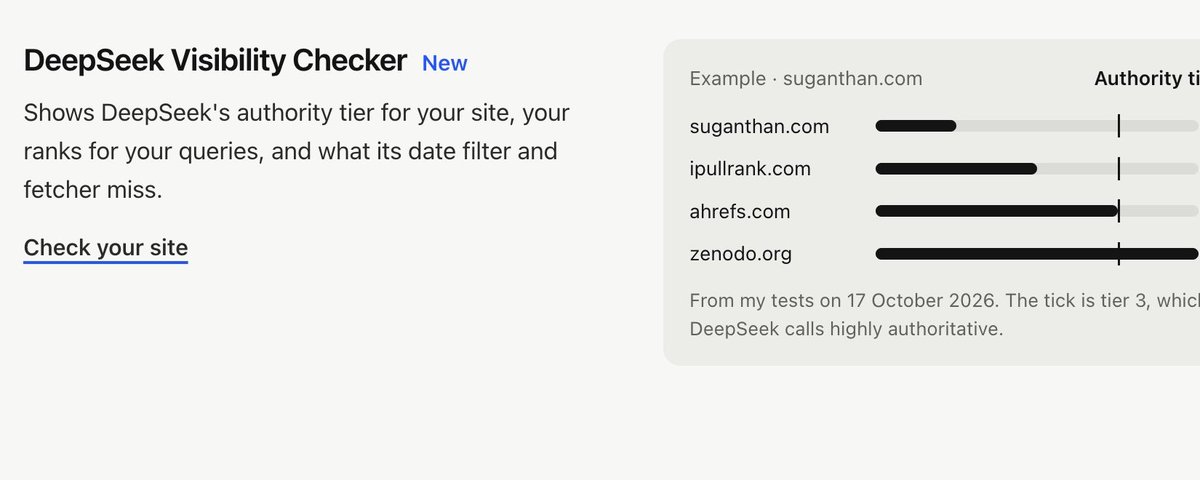
DeepSeek opened up its search API, exposing website authority scores, rankings and reranking scores.
I tested it, found some questionable results 😬 and built a free tool so anyone can check their own site without touching the API.
Here’s how it works.👇
Loganix retweeted

Jev is having a moment in SEO.
@SamUnderwoodUK tested it against a rubric rooted in Google’s Quality Rater Guidelines.
After refining the page context and questions, Jev agreed with expert reviewers within one level 82% of the time – for less than a penny per page.
Learn more here: samunderwood.co.uk/writing/j…
👀👀👀

DeepSeek just opened its search index to SEOs and developers.
Instead of just posting about the news like everyone else, I decided to actually test it.
110 API calls later, I’d spent a grand total of $0.08.
The API exposes authority scores, reranking scores and the sources it retrieves.
DeepSeek also claims to have protections against SEO and GEO spam. So I put that to the test.
My website got an authority score of 1 out of 4.
A “Free Robux Generator” PDF on a government gov site got 4 out of 4. The highest authority tier.
Sir, I’d like to speak to your manager. 😬
Jokes aside, this is a significant release for SEOs.
We can now query DeepSeek’s own search engine and inspect its sources, scores and rankings directly.
I’ve written up my preliminary findings, including some questionable rankings, spam results and how its fetcher accesses websites.
suganthan.com/blog/deepseek-…

Loganix retweeted

GEO to SEO TRANSLATION LIST
Here is a list of GEO/SEO potential overlaps and crossovers. Whilst I don't refute that GEO has its own merits, approaches and understanding/skill requirements, a lot of what makes GEO has an SEO overlap.
---------------
GEO:
We're going to increase mentions of your brand
SEO:
Build links
---------------
GEO:
Entity optimisation
SEO:
Entity SEO and knowledge graph optimisation
---------------
GEO:
AI Authority Building
SEO:
Authority building, digital PR and reputation
---------------
GEO:
AI content discoverability
SEO:
Crawlability, indexing and content discovery
---------------
GEO:
Answer-first optimisation
SEO:
Featured snippet optimisation and direct-answer content
---------------
GEO:
Conversational query optimisation
SEO:
Long-tail keyword targeting and search intent
---------------
GEO:
Semantic relevance optimisation
SEO:
Semantic SEO and topical relevance
---------------
GEO:
AI content extractability
SEO:
Clear headings, HTML structure and readable content
---------------
GEO:
AI-ready structured data
SEO:
Schema markup and JSON-LD
---------------
GEO:
Entity disambiguation
SEO:
Entity SEO, sameAs and consistent brand information
---------------
GEO:
Citation-worthy content
SEO:
Original research, useful references and link-worthy content
---------------
GEO:
Information gain optimisation
SEO:
Original content, unique insights and added value
---------------
GEO:
Cross-web consensus
SEO:
Digital PR, reputation management and independent corroboration
---------------
GEO:
AI brand authority signals
SEO:
Brand mentions, reviews and third-party coverage
---------------
GEO:
Topical entity coverage
SEO:
Topic clusters and comprehensive subject coverage
---------------
GEO:
AI freshness signals
SEO:
Content freshness and keeping information updated
---------------
GEO:
AI crawler accessibility
SEO:
Bot accessibility, robots.txt and server configuration
---------------
GEO:
Generative answer optimisation
SEO:
Answer Engine Optimisation / featured-snippet-style content
---------------
GEO:
AI citation optimisation
SEO:
Content attribution, digital PR and source visibility
---------------
GEO:
Prompt-intent mapping
SEO:
Keyword research, user intent and question mapping
---------------
GEO:
AI share of voice
SEO:
Share-of-voice tracking for AI answers
---------------
Now, before the GEO police arrive...Yes, AI search is changing how information gets discovered, synthesised and presented.
Citation tracking, brand visibility and prompt monitoring create new challenges, and theres genuinely important work to be done.
But can we stop pretending that everything weve spent the last 20+ years doing in SEO has suddenly become an entirely new discipline because someone put AI in front of it?
Googles own documentation says that optimising for generative AI search is still SEO.
No offence to the GEO experts. Especially the ones who were selling backlinks and guest posts 18 months ago. 😂

interesting!

ChatGPT appears to be adding new disclaimers to its answers to help users make better decisions, especially in categories that are easy to manipulate.
I’ve been tracking a long list of B2B software prompts in @peec_ai. Of ~700 ChatGPT answers, 82 included some kind of disclaimer in the past week, and 19 specifically warned users about who writes the rankings and reviews that ChatGPT draws on.
ChatGPT is cautioning users about:
❌ Vendors ranking themselves in their own comparison pages
❌ Publishers that are affiliated with one of the brands they review
❌ Entire categories where many comparison articles are written by companies selling those products (cough, AI visibility tools)
❌ Sponsored placements and paid-for reviews on review sites that affect which products show up first
❌ Recommendations that appear to exist mainly to promote affiliate links
❌ Taking vendor claims at face value
❌ Its own shortlist not being independently tested
❌ Sponsored/unbiased discussions on Reddit
I attached two screenshots from the prompt tracking export. The disclaimers are a small part of each answer, often a sentence or two at the end of a list of recommended brands.
Search engines have had systems in place for years to (try to) reduce the visibility of sponsored or manipulated content, but that work usually happens behind the scenes (ranking algorithms, reviews systems, spam policies). Now with disclaimers in AI answers, that information is directly visibile to the user and can affect their decisions.
I see these disclaimers as a temporary bandaid while the AI companies work out more sustainable ways to surface objective answers.
It also gives OpenAI some cover if ChatGPT ends up recommending not-so-great products from categories that are full of self-promotion.
It will be interesting to see whether these warnings actually lead users to do more research, or to be more skeptical of taking ChatGPT’s recommendations at face value.


Loganix retweeted

Attribution is dead.
The sooner you realise this and work beyond it, the better.
I'm channeling this 'tough love' approach into the brands I'm working with.
Here's what we're up against:
- Consent throttles user and session data in GA4, Triple Whale or whatever analytics platform you're using.
- LLMs are eroding UTMs in URLs
- Direct traffic is up for everyone globally
- Apple iOS and Safari delete marketing cookies after 24hrs killing user tracking.
- SEO and AI tracking tools are painfully unreliable. They're indicative at best.
- Attribution data is theredore patchy and unreliable.
Here's my approach:
- If you know your customer (which you absolutely should), you'll already know where to find them online.
You don't need unreliable attribution data to tell you that.
If you sell clothing / apparel to a younger audience, you'll find your customers on Snapchat, Instagram, TikTok.
If you sell anti-ageing skincare to an older audience, you'll find them on Facebook and Google.
But is that actually the case? 🤔
Marketing has never been about throwing all of your resource into a single platform.
It takes customers upwards of 15+ touchpoints to turn a stranger on the internet into a paying customer.
You've potential customers aged 35+ on Tiktok. You've Gen Z customers using Bing search.
More importantly, the number of ecommerce sales happening on marketplaces like TikTok shop is growing aggressively. You've zero chance of getting attribution data from those platforms.
Don't get me started on agentic commerce... Those customers never even visit your website to complete their purchases.
A click on a Google ad could drive a sale on TikTok shop.
An impression on Instagram could drive a sale on Amazon.
My point here is this. You need to drop obsessing over last click attribution and instead understand where your brand needs to collectively show up to win the customer.
In 2027, attribution will be heavily blended. At best you'll derive patterns and trends. No more 'cash cow' singular channels to go 'all in' on.
Arguably, there never was.
partnerships like this turn the open web into cable news
a concentration of media sources and idealogies


Loganix retweeted

Wait, guys. Am I the only one excited about this? 😍
With Mediavine's newly introduced reporting APIs, Insight Hive could now show you exactly how much EARNING each Facebook post generates from Mediavine ads, along with the RPMs, sessions for your URLs.
All WITHOUT having you to open your Mediavine dashboard!
As a publisher myself, I've wanted this feature for a LONG time. Imagine seeing your Facebook post's reach, engagement, traffic, and actual MV ad revenue, RPM all in one place.
The good news? I've already figured out the technical side, and it's ready to go. Just need to ship it!
Would love to hear from fellow publishers. Anything else you'd want to see in this feature?

Loganix retweeted

Best SEO content format for every funnel stage for B2B SaaS:
TOF:
- Free tools
- Checklists
- Templates
- Glossaries
- How-to guides
- Statistics pages
- Beginner guides
- Original research
- “What is X?” pages
MOF:
- Best X for Y
- Case studies
- Buyer guides
- Industry pages
- Use-case pages
- Integration pages
- Comparison pages
- Product-led guides
BOF:
- Demo pages
- Review pages
- Pricing pages
- Product pages
- ROI calculators
- Migration pages
- Implementation guides
- [Brand] vs [Competitor]

google got ahrefs drinking horcruxes

Incredible: Not only is Google working to block AI crawlers, but @nozzleio uncovered evidence that Google is deliberately serving FAKE search results to scrapers
The "poisoned" search results look real, but w/ garbage data. This influences AI crawlers, scrapers, & rank trackers.