
PhD @mldcmu. Previously @ucsd_cse @UcsdMathDept
Joined April 2020
- Tweets365
- Following396
- Followers1.2K
- Likes1.2K






Yuda Song retweeted

Check out @ZihaoZhao1's thread on our new paper!
We compare various techniques to mitigate privacy leakage, finding that synthetic data and LLM rewriting offers a particularly strong privacy/capability trade-off 📈📈

We’ve all offloaded the writing to LLMs, but have you considered REWRITING with LLMs? 👀
Rewriting your private data with an LLM before finetuning gives a better empirical privacy vs. capability trade-off than PII scrubbing or DP-SGD!
To test this, we generated 5,000 synthetic medical records with private information. Then, we finetuned Qwen3.5-4B and gpt-oss-20b with several methods to mitigate privacy leakage and asked two things: does the model learn from the medical records, and does it leak private information?
1/n 🧵👇

Yuda Song retweeted

On July 15, we released Schema, the first agent harness to reach ~99% RHAE on the ARC-AGI-3 public set.
Today, we’re sharing the full paper and code, with new results and a closer look at why Schema works.
xitter.cf/HavenFeng/status/20777…

Yuda Song retweeted

Huge thanks to @pratyushmaini and @AdtRaghunathan for all their work, support and feedback as we worked on this paper!

So proud of @gaurav_ghosal for the incredible work he’s put into bringing NULLs to life.
Even happier to see it recognized with the Best Paper Award at the COLM Privacy & Security Workshop!
This is exactly the kind of ambitious research academia should make possible!

Yuda Song retweeted
We are taking a big step towards scaling LLMs that can unlearn on demand.
Cleanly deleting data from LLMs has proven impossible: training entangles every source in shared weights.
NULLs (Natively Unlearnable LLMs) escapes this, keeping millions of sources individually deletable in a 1B-parameter model trained on web data. (1/8)
Yuda Song retweeted

Please come and join us for the COLM 2026 Lifelong Agent Workshop!
Location: Continental Ballroom #6
We are starting!

Yuda Song retweeted

Join us at MOSS tomorrow!
There's been lots of discussion about what one can meaningfully contribute w/o huge resources (e.g., in academia). We hope MOSS can offer some answers and inspire more conversations! 🌱
(panel poll results for those interested: form.typeform.com/reports/01…

MOSS @COLM_conf is happening tomorrow (Fri, Oct 9)!
Join us for talks and discussions on how small-scale research and experiments can advance both scientific understanding and algorithm insights. 💡
📍 Hilton Union Square, Theater 84
sites.google.com/view/moss-c…

Yuda Song retweeted

Very happy to see MaxRL making the AI's top 10 list!

The AI’s top 10, crediting first authors:
1) Spurious Rewards: Rethinking Training Signals in RLVR — @RulinShao
2) Learning to Discover at Test Time — @mertyuksekgonul
3) Revisiting Efficiency–Accuracy Scaling in Mixture-of-Experts Architectures — @venmugil
4) Reinforcement Learning via Self-Distillation — @jonashubotter
5) Maximum Likelihood Reinforcement Learning — @FahimTajwar10
6) AutoNumerics-Zero — Esteban Real
7) Reinforcement Learning with Evolving Rubrics for Deep Research — @RulinShao
8) Rethinking the Trust Region in LLM Reinforcement Learning — @QPHutu
9) Gromov-Wasserstein at Scale, Beyond Squared Norms — Guillaume Houry
10) Flowers: A Warp Drive for Neural PDE Solvers — Till Muser
Yuda Song retweeted

New work on Harness Optimization: Training a model to revise executable agent harnesses using execution feedback:
arxiv.org/abs/2609.35738
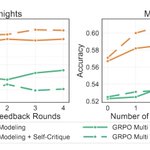
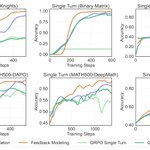
Trained with RL on downstream performance, the model learns to improve harnesses for unseen tasks. Across reasoning and multi-hop question answering, harness learning improves performance over successive revisions.
The key idea is that the model learns how to adapt, while the harness is what changes. These revisions reshape how an agent organizes computation, uses tools, and passes information across model calls.
Models trained on single revisions can continue improving harnesses over multiple rounds, suggesting that harness design can become a reusable and generalizable adaptation skill.
See an excellent thread by @ZAlvin39105.


1/8
How do we train a model to adapt to tasks it has never seen, without updating its weights at test time?
With Harness Learning, we train a model to revise harnesses using execution feedback. At test time, the model applies this learned skill to improve harnesses on unseen tasks, while model weights stay fixed.
Improving agent harnesses takes experimentation. We want a model to learn from those revisions and make better edits on unseen tasks.
Models trained with harness learning nearly double their performance on challenging unseen reasoning and multihop question-answering tasks.
Yuda Song retweeted

Computer-use agents are extremely good!
But they need to improve on a metric which most benchmarks don't track. How much time do CUAs take to complete a task?
Introducing cua-speedrun: a benchmark for accuracy, speed, and cost under matched infra.
cuaspeedrun.com
👇🧵
Yuda Song retweeted

There’s lots of buzz around agentic harnesses for robots, particularly for long horizon tasks that require complex reasoning and memory. But what will it really take to turn a reasoning agent into a reactive, reliable and low-latency robot policy?
In our new paper, workspace models, we design a new memory architecture that acts as a latent harness for stronger reasoning models. Here’s why we think this might be the way forward:
(1/9)

Yuda Song retweeted

new blogpost about beginner-level advice on breaking down proofs, which I feel students new to theory may find helpful especially at this time where most derivations are done with the help of LLMs: nanjiang.cs.illinois.edu/202…
Yuda Song retweeted

In our Nature paper, we introduce the first superhuman Stratego AI, which we built using general techniques that we developed for RL & test-time compute under imperfect information. 1/N

Yuda Song retweeted

Starting tomorrow, our lab will hold an open-source week: 2 software frameworks, 4 papers, all building a coherent ecosystem.
The theme: Frontier AI on Hardware You Own
Blog post: timdettmers.com/2026/09/21/d…
SoTA results in:
Autocompaction
Autonomous Research
Model compression
Test-time scaling
Deep Research
And a healthcare RL environment giving you a new level of complexity to train healthcare agents.
The ecosystem that we will release is built to be as usable as possible. Agent sessions that run overnight and go on for tens of millions of tokens is made easy. Model compression of a model is automatic: you just get a good model that runs fast locally -- no expertise required. An autonomous research that works out of the box.
Our ecosystem enables a new level of work that can be done locally.
Yuda Song retweeted

AI4Maths: we’re hiring!
My team at Meta FAIR in Paris has postdoctoral and full-time research positions open.
Come join us if you’re excited about:
- Making frontier models better at maths
- Proof assistants and formalizing mathematics at scale
- Working hand in hand with the mathematical community to shape the future of mathematics—beyond “big model solves big problem”
Apply here:
Postdoc: metacareers.com/profile/job_…
Research Scientist: metacareers.com/profile/job_…
Research Scientist: metacareers.com/profile/job_…
@AIatMeta
Yuda Song retweeted

Existing continual learning methods still suffer from catastrophic forgetting. Our recent work found a simple recipe to improve 𝗹𝗼𝗻𝗴-𝗵𝗼𝗿𝗶𝘇𝗼𝗻 𝗺𝗲𝗺𝗼𝗿𝗶𝘇𝗮𝘁𝗶𝗼𝗻 substantially:
Composing multiple continual learning mechanisms extends memory lifetime and raises average final retention from 1.2% to 34.9% across 3 datasets: a 28-fold improvement over naive sequential SFT.
Project page: compose-cl.github.io/
Alphaxiv: alphaxiv.org/pdf/2609.compos…
Arxiv: arxiv.org/abs/2609.06986
Code + datasets: github.com/cozheyuanzhangde/…
Yuda Song retweeted
Check out our new work on Tail-Likelihood Reinforcement Learning (TailRL), extending maximum-likelihood RL from binary to continuous rewards.
arxiv.org/abs/2609.02987
Rather than optimizing only mean reward, TailRL maximizes the expected log of upper-tail probabilities, naturally placing more weight on rare, high-reward rollouts. Its gradient can also be interpreted as a mixture of Best-of-(k) gradients.
TailRL requires only a simple modification to the advantage function, making it easy to integrate into existing RL pipelines. Across object localization, maze navigation, GUI grounding, and code optimization, TailRL effectively exploits rare high-reward samples and scales better with increased inference-time sampling.
Check out a detailed thread by @stablegradients.


Is RL optimizing the right objective? 🤔
Should we maximize mean reward? Best-of-k? Which k?
Standard RL pulls on the mean and often the distribution collapses to a spike. The tail dies 🥲
We introduce Tail-Likelihood Reinforcement Learning (TailRL).
It maximizes the mean reward while simultaneously maximizing coverage over high reward outputs.
🧵 1/n
Yuda Song retweeted

“Tail-Likelihood Reinforcement Learning”
Standard RL optimizes average reward, which can suppress rare but exceptional outputs and hurt Best-of-k scaling.
This paper instead optimizes the probability of exceeding every reward threshold, giving more weight to rare high-reward rollouts.
Its gradient becomes a harmonic mixture of Best-of-k objectives across all k, helping preserve exploration and inference-time scaling, with up to 256x fewer samples on GUI grounding and 7.7x Best-of-1024 speedup on code optimization.
alphaxiv.org/abs/2609.02987

Yuda Song retweeted

MaxRL but for continuous rewards! Lots of interesting math in here 👇
Is RL optimizing the right objective? 🤔
Should we maximize mean reward? Best-of-k? Which k?
Standard RL pulls on the mean and often the distribution collapses to a spike. The tail dies 🥲
We introduce Tail-Likelihood Reinforcement Learning (TailRL).
It maximizes the mean reward while simultaneously maximizing coverage over high reward outputs.
🧵 1/n
Yuda Song retweeted
After MaxRL, we continued wondering if there is a principled extension to non-binary rewards. TailRL extends maximum-likelihood RL from binary to continuous rewards!
Check the wonderful thread below by @stablegradients
Is RL optimizing the right objective? 🤔
Should we maximize mean reward? Best-of-k? Which k?
Standard RL pulls on the mean and often the distribution collapses to a spike. The tail dies 🥲
We introduce Tail-Likelihood Reinforcement Learning (TailRL).
It maximizes the mean reward while simultaneously maximizing coverage over high reward outputs.
🧵 1/n
Yuda Song retweeted

Some life updates:
1. I defended my PhD last winter 🎓
2. Starting next January, I’ll be joining the faculty in Computer Science at @cornell_tech! 🗽
I’m incredibly grateful for the past few years at CMU and Datology, especially to @zicokolter and @zacharylipton for their mentorship, and to @AdtRaghunathan, who I’ve had the privilege of working closely with.


