Scientist. Personal account.
Madrid, Spain
Joined September 2022
- Tweets1.3K
- Following154
- Followers299
- Likes1.6K




Lucas Tafur retweeted

Glutamine + chemo in pancreatic cancer: Phase 1 GlutaPanc, n=16, 81% cachectic at baseline. 30g/day oral glutamine + full-dose gem/nab-paclitaxel, no glutamine DLTs. ORR 44%.
nature.com/articles/s43018-0…

Lucas Tafur retweeted

🚨 New paper from the Bustamante Lab in @NatureComms! Our study reveals how the central coupler of ClpXP helps coordinate its subunits to convert chemical energy into mechanical force
Check it out! 👇
doi.org/10.1038/s41467-026-7…
Lucas Tafur retweeted

Today, our work in partnership once again with @SternbergLab presenting the structures of several DRT10 bacterial defense systems and comprehensive analysis of their mechanisms of action is published… very happy!
Great work guys!
nature.com/articles/s41586-0…
Lucas Tafur retweeted

Interested in cancer metabolism? We have a 4y FPI-funded PhD student position available in my lab to study the metabolic interplay of cancer cells and their microenvironment.

Lucas Tafur retweeted

Happy to see our paper, led by outstanding postdoc Alessandra Esposito, out in @Nature today. We uncovered a TBK1/ULK1 signaling pathway that acts as a lysosome quality control mechanism, regulating the FLCN-TFEB axis in response to lysosomal stress
Link: rdcu.be/icEViqq6F68a

Lucas Tafur retweeted

No es que no estén validados (que no lo están), es que su fundamento científico es entre endeble y nulo, más cerca de nulo, a día de hoy.

👏🏻👏🏻
“No tiene ningún sentido hacerse test de microbiota, no están validados” @rosacampo agenciasinc.es/Entrevistas/N…

Lucas Tafur retweeted

Why do muscle fibres shrink with age?
Not because myofibrils get smaller — because there are fewer of them.
We followed this from whole-muscle down to individual myofibrils, in humans and mice, across ageing and disuse.
Tweetorial below
Open Access here: physoc.onlinelibrary.wiley.c…


1/ Why do muscles atrophy with aging and disuse?
Is it because each tiny little myofibril gets smaller… or is it because we lose myofibrils?
In our new study, we addressed this in humans and mice. biorxiv.org/cgi/content/shor…
Full breakdown of the findings in this thread 👇
Lucas Tafur retweeted

Finally a more intuitive way to learn pLDDT/pAE? 😎
sokrypton.github.io/protein_…
(Character idea from @HannesStaerk & Alex Waldherr)
Lucas Tafur retweeted

This is legitimately terrible for OpenAI --- but also Anthropic --- and it relates to their work in drug discovery.
I read this as: prompts will be monitored and potentially acted on if we think there’s something scientifically and/or commercially valuable being disclosed.
Now, the big problem for Anthropic is that they are increasingly seen to be competing with their customers. Outside of SF, many people also think of OpenAI/ChatGPT and Anthropic/Claude as somewhat interchangeable companies and products --- aka, if OpenAI do something, surely Anthropic will do it too?
As so much IP relates to drug targets and people disclose these to Claude, I think we will see a lot of pharma companies stop using these tools or put up a lot of internal guardrails.

wtf is this way to handle mathematicians work and scientific communication
TLDR: Leven and Tristan worked over several months on one of the Millenium Prize Problems with various AIs to reach final interesting results. OpenAI apparently heard about it in the last days and prompted their latest models to work on the direction Leven and Tristan found fruitful. They then tried to push for controlling communication of the result and dropping Leven from authorship with some very bad taste social pressure.
Hope this is not a glimpse of the future we’ll get in science research with these dominating players playing marketing games hurtful for the real scientific community.

Lucas Tafur retweeted

Guys we need to get serious here: The new paper barely nudges our priors on GLP-1 for longevity.
I'm spending every waking moment pushing for progress on longevity, but what's going to get us there is scaling up truth-seeking, not giving in to slopulism.
Publishing this in Nature is IMO a failure of human taste and judgement.
First, the sema mice don't really live longer than healthy controls in other studies (see pic). If you stop there, this should be seen as 'nice someone did this, now do it more carefully'. This may be robust life extension it may not.
Second, we already know reduced food intake extends mouse lifespan. Why is there are whole figure comparing CR and sema effects, but no lifespan for matched food-intake? Because it should turn paper into 'sema reduces mouse food intake'
If you want to keep going, why females only? Blah blah male aggression, that doesn't stop various ITP interventions from working in males.
Or is it that constant injections shorten lifespan, possibly via ulcerative dermatitis which is more common in females? No non-injected control group, can 't say.
Fig 3 "GLP-1 ... alleviates the hallmarks of ageing and mimics the calorie restriction response" yes reducing food intake is similar to reducing food intake.
Fig 4 "modulates the genetic regulators of ageing" -> Show a bunch target genes many of which have been tested and don't nudge lifespan.
I'm glad someone did this study, I'm not saying it's not a contribution or should be retracted, but the reason this is in a tier 1 journal is because it'll get attention (boosted by hypefluencers). Apparently some journals are just giving up; I understand that the multi-year assault on truth-seeking is really hard, it's hard to imagine journals not getting replaced by AI if they lean into slopulism.


New paper @Nature: Semaglutide recapitulates many of the benefits of caloric restriction in female mice & extends lifespan by almost 100 days. Males not yet tested for lifespan
Below: Red traces = mouse movement

Lucas Tafur retweeted

New paper in @MolecularCell! A great collaborative effort to uncover how the lncRNA CONCR works. Terrific teamwork with the labs of @MaiteHuarteLab @OscarLlorcaCNIO @ChillonIsabel and supported by @FundlaCaixa cell.com/molecular-cell/full…
Lucas Tafur retweeted

Un conflicto de interés de enormes dimensiones acaba de ser descubierto: un cardiólogo presidente de la sociedad europea promovió y recomendó el uso de un medicamento sobre el cual existen dudas de su seguridad y eficacia, y recibió 50M£, via @bmj_latest
bmj.com/content/394/bmj-2026…

Lucas Tafur retweeted

Probably the most uninformative figure ever created

A new Clinical Practice article summarizes the classification, evaluation, risk stratification, and management of syncope. History, examination, electrocardiography, and orthostatic blood-pressure measurement identify the cause in most patients.
Read “Syncope” by Rose Anne Kenny, MD, DSc: nej.md/4cjFuVU
Ask AI Companion to provide a summary of this article for your patient. In Spanish.

ALT A flowchart from the Clinical Practice article "Syncope" by Rose Anne Kenny, M.D., D.Sc., that shows the general principles for initial evaluation of all patients after an episode of syncope. The chart includes steps such as suspected syncope, evaluation, history taking, and an ECG. It categorizes causes of syncope as certain or uncertain, leading to risk assessment and further evaluation or treatment.
Lucas Tafur retweeted

A tool used to rephrase plagiarised text changed "final solution" to "mass killing of an ethnic group" in a chemistry paper. Now retracted thanks to a PubPeer user who spotted this.

Lucas Tafur retweeted

Our latest work is now out! Congratulations to the whole team on this publication. Happy reading!

#CIBpapers
The group led by Dr. Carlos Fernández Tornero at @CIB_CSIC, in collaboration with the company @PhrmMar, has revealed key structural features of ecteinascidins binding to DNA.
🔗cib.csic.es/news/research/dn…
cc: @CSIC, @CSICdivulga

Lucas Tafur retweeted

Amidst all this discussion of the COVID origin docs released recently by the Senate committee, I remain dumbfounded by the CONTINUED lack of interest of the scientific community into where this pandemic came from.
Whatever you think about the motivations of the people who wrote the Proximal Origins paper (and the documents certainly call those into question), the effect of this on the scientific community writ large was to signal that the official stance was "natural origin" and that any questioning of that claim, let alone investigations into it, were anti-science conspiracy theories.
I'm hardly a lab leak proponent - I've said all along that my prior was natural origins, although that's shifted a bit with subsequence disclosures - but it was really quite ugly how even being publicly open to the possibility of lab leak was treated as an apostasy - despite the fact that many scientists agreed in private.
I hope scientists - especially those with political or other influence - will reflect on this and when called upon to discuss scientific issues of great public import will place far less emphasis on "controlling the narrative" and instead will emphasize protecting public inquiry and being personally open minded.
Lucas Tafur retweeted

Behind closed doors, the scientists who authored the Proximal Origin paper privately questioned their own conclusions. Publicly, however, they shamed, attacked, and censored those who raised legitimate questions—all in the name of damage control.
Lucas Tafur retweeted

New preprint! Do all kinase domains have similar activation mechanisms?
We steer AlphaFold2 using "transfer seeding" of known kinases to sample 8.3 ms of MD simulations via Folding@home. We find that the pathways are different and kinase-specific!
Link: doi.org/10.64898/2026.06.26.…
Lucas Tafur retweeted

A dietary switch promotes sensory neuron–dependent cancer-associated cachexia | Science science.org/doi/full/10.1126…
Lucas Tafur retweeted

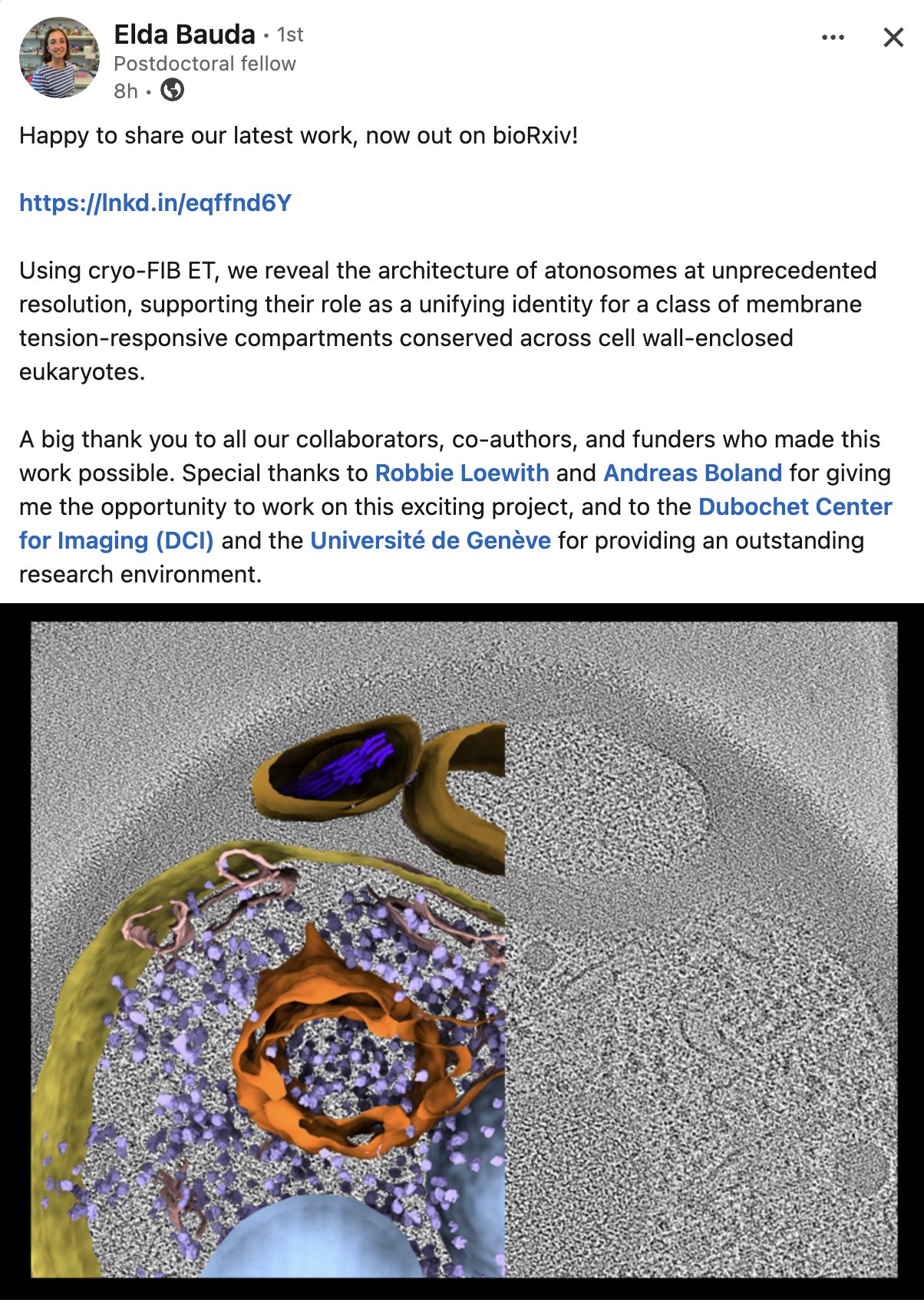
Sharing a LinkedIN post from Elda Bauda, a postdoc in our group.
She's a fantastic researcher and has made some fundamental discoveries . Please have a look at her post and the paper here
lnkd.in/eqffnd6Y
"Using cryo-FIB ET, we reveal the architecture of atonosomes ..."